Critique of the Proposed Civil Aviation Law Regulations (1996)
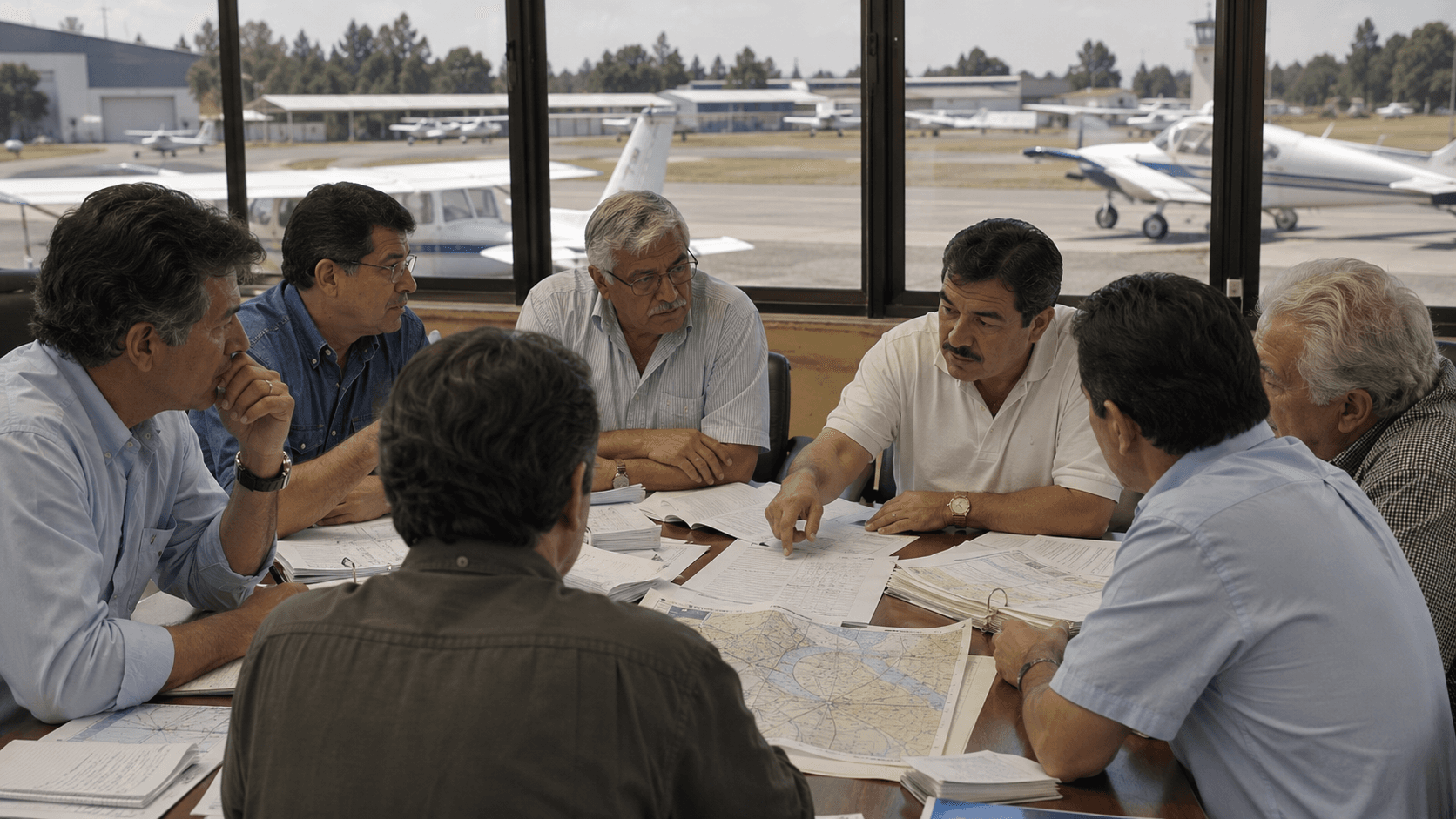
Opinion article critically examining the proposed Regulations to Mexico's Civil Aviation Law in 1996. The author argues that the regulatory proposal applies standards intended for commercial aviation to private and recreational flying, creating disproportionate requirements, operational ambiguities, and restrictions that could hinder the development of general aviation in the country.
Prepared on July 6, 1996
Aircraft: —Tower, this is Alpha Papa Zero One, I have an engine failure and need assistance.
Tower: —Alpha Papa Zero One, proceed.
Aircraft: —I have an engine failure and need assistance!
Tower: —Alpha Papa Zero One, if you require distress assistance, please use the phraseology specified in Article 262 of Chapter XII, First Section, Second Part, of the Regulations to the Civil Aviation Law.
Aircraft: —Mayday, mayday, mayday, this is Alpha Papa Zero One. Mayday, mayday, mayday, this is Alpha Papa Zero One. Mayday, mayday, mayday, this is Alpha Papa Zero One. I have an engine failure and need assistance!
Tower: (silence)
Aircraft: —Didn't you hear me, Tower?
Tower: —Alpha Papa Zero One, according to the Regulations you must pronounce the word "over" at the end of your distress call. State estimated position and time, heading, altitude, aircraft type, nature of the emergency, and actions the pilot in command intends to take.
It's laughable, but in fact the proposed Regulations to the Civil Aviation Law specify the exact words to be used in "distress communications" and the number of times they must be repeated. At the same time, they leave important matters undefined, apparently following what they say a general who once served as President of our country used to say: a good law should be ambiguous enough to allow favors for friends and punishment for enemies.
It was to be expected that the Regulations to the new "Civil Aeronautics Law" would be as poorly drafted as the Law itself and would also give private aircraft the same treatment as public transport aircraft, forgetting the legal principle that states that "equal treatment for unequal parties is as unjust as unequal treatment for equal parties."
From the wording of Article One, the tendency of the Regulations is evident: "The purpose of these provisions is to regulate the exploitation, use, and enjoyment of the airspace located over national territory with respect to the provision and development of air transport services pursuant to the Civil Aviation Law." The fact that "use" is mentioned after "exploitation" says much about the subconscious of whoever drafted the Regulations.
The first article dealing at all with private non-commercial aviation is Article 23, which states that "aero clubs and model aircraft clubs shall require authorization from the Secretariat for their aerial activities." The sin of over-regulation, as a friend says. Surely aviation inspectors will show up during recess at elementary schools that are not authorized in order to confiscate rubber-band airplanes and kites. It is worth remembering that Generalissimo Franco prohibited radio-controlled aircraft in Spain because he feared someone might fly one through his window carrying a bomb, without reflecting on the fact that criminals do not go around asking for permits.
The Regulations devote only three articles specifically to "private non-commercial air transport." Article 60 defines non-commercial flight as one "conducted without profit motive and intended to: I. Attend to the needs and interests of the owner or possessor when such person is a natural person, including recreational purposes... which do not require specific authorization..."; Article 61 establishes that aero clubs "must be organized as civil associations and operate under the conditions specified by the corresponding regulations" without identifying them; and Article 62 states that "the practice of air sports may only be carried out in locations and under conditions established by the Secretariat." Since nothing is defined, it will likely be left to whoever "applies the Regulations" to decide whether flying at five hundred feet over the beach on Sunday is recreational or sporting activity.
Title Four addresses "Aeronautical Technical Personnel," and as throughout the Regulations, the commercial aviation perspective prevails. Article 109 states that "for obtaining aeronautical technical personnel licenses, applicants shall submit a professional license, degree, or certificate issued by a training institution, as well as such documents as may be established in each case by the corresponding regulation." In other words, it does not allow a person engaged in other occupations who simply wishes to fly recreationally to receive private instruction at the nearest airfield from a licensed instructor and demonstrate knowledge through an examination, as was done in Mexico and continues to be done throughout the world.
Article 111, concerning license classifications, establishes "...IV. Ultralight aircraft pilot licenses: a) private and b) commercial." Once again, the sin of over-regulation. Mexico will probably become the first free country requiring a license to fly an ultralight, but also the first permitting ultralights in commercial operations (otherwise why create a commercial license?). Perhaps due to lack of imagination by the drafter, this article failed to include model aircraft licenses (private and commercial) in order to remain consistent with Article 23. In other countries ultralights do not require licenses but are prohibited from operating in controlled airspace and from landing at airports. Here we have seen them taking off from taxiways, yet they will require licenses.
Article 116 states: "To hold an aeronautical flight personnel license, the applicant must be Mexican by birth," and adds in a footnote: "Since, pursuant to the third paragraph of Article 32 of the Constitution, pilots and in general all personnel crewing an aircraft flying under the Mexican flag must be Mexican by birth." The Constitution does not establish such nonsense; Article 32 states "...all personnel crewing any vessel or aircraft flying under the Mexican merchant flag or insignia." The Constitution's intention is to preserve employment opportunities for Mexicans, but any foreigner, and certainly any naturalized Mexican, may crew a private fishing boat and should have the right to obtain a Mexican license to fly a Mexican aircraft for non-commercial purposes. In the United States, any private pilot holding a Mexican license is immediately granted an American one upon demonstrating English proficiency and knowledge of U.S. regulations, because it is a way of promoting development by making it easier for tourists to rent local aircraft. Would it not be logical to do the same in Mexico and encourage our development?
Article 150 states that "No person other than flight crew members may: I. Use aircraft controls in flight. II. Enter the cockpit. III. Occupy additional cockpit seats." Once again, no distinction is made between a Cessna 150 and a Boeing 747. Is the right front seat of a single-engine aircraft equipped with dual controls an "additional cockpit seat"? Has it not always been one of the ways to spark interest in aviation by allowing a passenger, under pilot supervision, to take the controls in flight and "feel" the airplane? In other countries there are even aviation promotion programs in which private pilots take children flying and allow them to "feel" the controls for a few minutes.
Article 188 establishes that "all aircraft conducting visual flights shall carry at minimum the following instruments: ... IV. A vertical speed indicator. VI. A turn-and-bank indicator..." These instruments are not even required for certification of single-engine aircraft in their countries of origin, and many older airplanes have neither panel space available nor electrical or vacuum systems to support them.
Article 189 requires that aircraft flying "under instrument flight rules... III. Two precision altimeters... and... IV. An airspeed indicator equipped with an anti-ice system." It requires pitot heat based on the rules under which the aircraft is flying rather than the actual flight conditions, and requires two altimeters instead of one altimeter and an alternate static source to guard against the most common altimeter failure, which another altimeter would not prevent.
Article 197 states that "aircraft shall carry one life vest for each person on board when: ... II. Taking off from or landing at a civil airport where the departure or approach path is arranged over water such that, in the event of a mishap, a forced ditching is possible." Thus, when a coastal airport tower instructs a Cessna 150 to extend its initial approach because a 727 is on final, the pilot should respond: "Sorry Tower, Article 197 prevents me from doing so; I am turning final."
Article 199 states that "aircraft operating over land areas designated by the Secretariat as difficult search-and-rescue zones shall carry at least one emergency locator transmitter... Aircraft shall also be equipped with the necessary pyrotechnic distress signaling equipment and life-sustaining means appropriate to the area over which they fly." Does this mean that, contrary to worldwide practice and ICAO recommendations, ELTs will not be mandatory for all aircraft? But if one flies in a "difficult search area," one must carry pyrotechnic explosives on board (even though there are no means for conducting nighttime searches) and "life-sustaining means"—a 12-gauge shotgun to hunt rabbits, for example, a first-aid kit, or perhaps a bag of potato chips?
In Chapter V, "On Communication and Navigation Equipment On Board," Article 202 states that "aircraft shall be equipped with radio equipment covering all radio frequencies assigned to civil aviation and capable of the following: ... III. Two-way communication at any time during flight with at least one aeronautical station..." The frequencies assigned to civil aviation include those used by DME, VOR, NDB, LORAN, GPS, marker beacons, ILS, radar, and so forth. According to this article, all of them would have to be carried on board, together with perhaps a satellite communications system in order to maintain communication while flying at two thousand feet and one hundred miles from the nearest station.
Chapter VI, "Maintenance and Aeronautical Repair Stations," likewise makes no distinctions, as if every aircraft were a 747 maintained in a large repair facility rather than, as with most single-engine airplanes, by an independent mechanic in the aircraft's own hangar.
Article 232 states that "flight crew members may not fly more than 90 hours per month or more than 1,000 hours per year." This is of little importance to private pilots because we all fly much less than that annually, but it demonstrates the drafter's knowledge, since ninety hours multiplied by twelve months equals 1,080 hours, which he apparently considered excessive for the human body.
Article 242 states that "No passenger, including authorities, may bring firearms or dangerous articles onto an aircraft that may endanger flight safety..." The crew, of course, may do so (and carry the 12-gauge shotgun to hunt rabbits and comply with Article 199 mentioned earlier).
Article 264 states that "A distress call and message may be transmitted by any other aircraft or vessel when they observe that the aircraft in danger is unable to transmit the message itself." Presumably this refers to aircraft that have already crashed, because those still in flight are required by Article 202 to "maintain communication at any time with at least one aeronautical station."
In short, the Regulations appear to have been drafted by people who know neither aviation nor law, but above all who ignore the fact that most aircraft operating in Mexico and throughout the world are private and small. It is obvious that the technical personnel of the DGAC, who have years of experience and do know aviation, did not participate in their drafting.
It is inequitable for the Civil Aviation Law and its Regulations to measure private aviation and public transport with the same yardstick. Both documents should be thoroughly reviewed by people knowledgeable in the field, listening to the viewpoints of all those who make up Mexico's civil aviation community, and modified accordingly.
José López del Puerto (translated in 2026 by ChatGPT)