The Rosario de Amozoc: The Ordeal of Registering Rural Airstrips (1998)
A first-hand account by Clemente Maitret describing the bureaucratic challenges involved in renewing permits for seven private ranch airstrips in Veracruz and Chiapas during the late 1990s. The article details extensive administrative requirements, environmental inspections, interactions with military authorities, and repeated regulatory delays, illustrating the obstacles faced by rural general aviation operators in maintaining legally authorized aerodromes in Mexico.
THE ROSARIO DE AMOZOC
By Clemente Maitret
In Mexico, we say that something is like the "Rosario de Amozoc" when it takes a very long time and ends badly. I am going to recount the "Rosario de Amozoc" that the registration of our airstrips has become. I say recount because the only written evidence I have consists of my applications to the authorities.
In March of last year, the permits expired for the seven airstrips we operate on our ranches:
Piedras Negras, Veracruz (AHO); El Cristo, Tecolutla, Veracruz (CRX); San Antonio, Juanita, Veracruz (SNX); Finca Lorena, Sayula, Veracruz (LON), which has been operating since 1958; Finca San José Moralar, Sayula, Veracruz (MRR); Rancho Los Pericos, Las Choapas, Veracruz (LPX); and Rancho 5 de Mayo, Palenque, Chiapas (CMF).
These permits had been valid for two years. To obtain them I had to comply with countless requirements and inspections carried out by DGAC personnel at our expense.
Naively, I thought renewing the permits would simply require a quick flight to each airstrip so that a local DGAC inspector could take photographs and verify that the strips were in exactly the same condition as they had been two years earlier.
When I learned that all the documentation had to be sent to Mexico City, I considered hiring an intermediary to handle the process, but discovered that he wanted to charge me, "as a favor," 10,000 pesos per airstrip. I decided instead to deal directly with the Aerodromes Directorate, whose personnel were already familiar with the airstrips.
Through a fax, they sent me a long list of requirements needed to register the airstrips. I called and explained that this was merely the renewal of permits for active airstrips, not new registrations, and that they already possessed the information I had submitted two years earlier.
To my surprise, they replied that none of that mattered anymore and that I would have to submit everything again, including:
Certified official identification of the aerodrome owner.
Articles of incorporation and powers of attorney if owned by a legal entity (also certified).
Original certificate of no criminal record.
A letter from the municipal authority stating that the aerodrome was not located on land designated for roads, bridges, or other projects of social interest.
(This consumed considerable time, money, and effort. Convincing municipal authorities—in this case, those of five different municipalities—to sign such a letter was a genuine accomplishment. The lack of knowledge among local authorities regarding aviation is enormous, and merely hearing the words "airstrip" and "airplane" makes them nervous. These documents also had to be submitted in original form.)
A letter from SEMARNAP certifying that no harm was being caused to the environment, flora, or fauna.
(Once again I encountered ignorance. Local SEMARNAP officials had no idea what they were supposed to do and took more than a month just to tell me that. Two and a half months after a more specific request, they informed me that they lacked the personnel and resources necessary to conduct the inspection. I offered to pay all expenses and personally fly them to each airstrip in my aircraft. They finally accepted, and we departed from Xalapa to carry out the inspections. The flight was uneventful, with the normal turbulence typical of our region, but by the time we reached the second airstrip, AHO, the SEMARNAP personnel were terribly airsick. They told me they had seen enough, that there was "no problem," and asked me to return to Xalapa. A month after the "inspections," they finally delivered the certifications.)
Location maps and aerodrome diagrams indicating the location of a large number of required services, such as firefighting equipment and an ambulance.
(This was easy because I already had them. In fact, I had already submitted the same plans three times.)
Payment of registration fees to the Aeronautical Registry.
(Again?)
When I finally assembled everything they requested, I submitted it in Mexico City.
Weeks passed without a response.
When I asked what was happening, I was told that documents were missing—documents that I had submitted and that had been misplaced, although they would not admit it. I had to certify and resubmit articles of incorporation, birth certificates, and other paperwork.
In what seemed to me the ultimate absurdity, they asked me to sign the renewal applications again because the applications I had originally submitted to begin the process were already more than a year old.
Meanwhile, as time passed, the Army became increasingly impatient with me. They demanded the DGAC permits and, quite reasonably, believed that I was stalling.
During one of the two inspection visits we made to Los Pericos, soldiers were positioned around the airstrip. When they surrounded the aircraft pointing high-powered weapons at us, the inspector nearly fainted.
I knew the soldiers were there, and they knew me, but even so they kept us "detained" for more than two hours until their commanding officer arrived and approved our release.
After this "Rosario de Amozoc," beginning on July 8 our airstrips were once again within the bounds of "legality" and officially ceased being "clandestine."
The DGAC was kind enough to grant us provisional permits valid for 180 calendar days for each airstrip (except for the Palenque airstrip, which received only 60 days).
After everything I had gone through, I expected permanent permits or at least two-year permits like the previous ones.
Unfortunately, that was not the case, and I was informed that I would have to apply for new provisional permits within the ten days preceding the expiration of the current authorization.
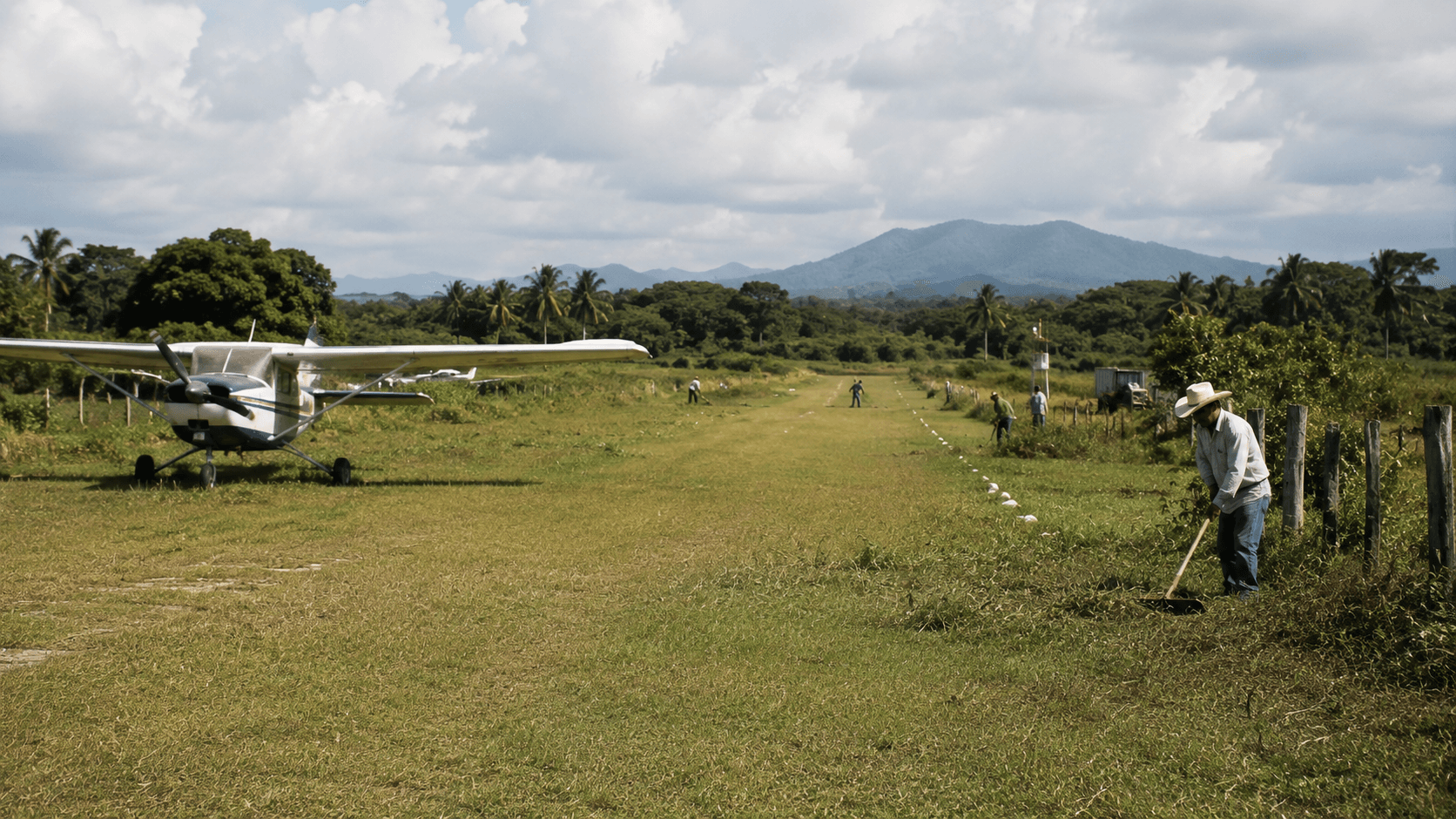
We have begun removing the "temporary" obstacles placed by the Army and cutting the grass on the airstrips, which had already grown to more than one meter in height.
I have made twenty copies of the authorizations and, while the airstrips are being restored, I will travel throughout the region delivering them to military and police commands as well as municipal authorities, as I promised.
After that, honestly, I do not know what to do.
It has been an extraordinarily frustrating experience.
I tried to do everything legally and personally, without using intermediaries, and I ended up exhausted.
I cannot continue neglecting my work every six months in order to obtain permits.
We have spent forty years flying and operating the airstrips on our ranches honestly, and never before have we encountered so many difficulties in keeping them legal.
What is happening in our country?
What can we do to remedy it?
(Translated by ChatGPT in June 2026)