The Last T-34 in Mexico: A Journey to Oshkosh and a Farewell to a Mentor
Alejandro Parra recounts his journey flying his Beechcraft T-34 Mentor from Mexico to Oshkosh, Wisconsin, to participate in AirVenture and formation-flying activities with fellow Mentor pilots. Beyond the trip itself, the article reflects on the growing challenges of operating historic and general aviation aircraft in Mexico and on the cultural and emotional significance these aircraft hold for their owners and the aviation community.
THE LAST T-34
by Alejandro Parra
On June 16, I hosted a lunch for my pilot friends to say goodbye to the last Beechcraft T-34 Mentor in Mexico — that is, mine — because my plans were to take it to the Oshkosh airshow and from there to Tennessee, to a workshop specialized in Mentors, to have it detailed, put a U.S. registration on it, and sell it.
At the end of June, I had a few days off, which I used to take the Mentor to Oshkosh, since I would not be able to do it in July because of work. Although my vacation would begin on the 24th, I wanted to be there for the formation flying practices that would take place from the 25th to the 29th, the opening day of the famous festival.
The cross-country flight was in wonderful weather, accompanied by my good friend Fernando Carrera, a Mexicana Fokker 100 pilot, who has only a few hours of experience in single-engine piston aircraft, since he had the good fortune of being hired just after obtaining his license.
I met him in Tampico, and we flew to Brownsville, Texas, where we were very warmly received and went through immigration and customs procedures. We continued on to Mustang Beach, where Jim Smith was waiting for us and hosted us.
The next day, after getting excited watching the game in which Mexico tied the Netherlands, we went to the runway and I flew with Jim and his two sons, one a USAF test pilot and the other a private pilot. After that, Fernando and I took off for a small airport on the outskirts of Houston to refuel, and from there to another one near Little Rock, Arkansas.
Once again we arrived to fumigate — sorry — visit a friend named Jim. This time his last name was McNeill, and he was already waiting for us at a beautiful grass strip located on a peninsula, surrounded by the homes and hangars of a dozen pilots and their aircraft.
With pride, Jim showed us the RV-6 he is building, almost finished and with a new engine, and a Piper Pacer he is restoring. After a refreshing dip in the lake — very welcome, since it was very hot — we ended the second day of the trip.
The next morning, our friends took us by boat to have breakfast at a restaurant on the shore of the lake, and at noon we resumed our trip, landing that afternoon in McComb, Illinois. On this leg I made Fernando suffer, because it was his turn to fly in the back as navigator, and I, feeling mischievous, turned off the GPS and told him: “Give me headings, distances, and times from here to McComb, and I want you to identify every town we pass along the route.” “At least give me a refresher on how to use the plotter and flight computer, because I’ve forgotten,” Fer grumbled, but I kept quiet and left him there suffering and sweating bullets. His navigation was off by about 30 miles, but considering his limited experience in these matters, the reduced visibility, and the fact that we occasionally flew above some clouds, he did not do all that badly.
From McComb to Oshkosh it was Fer’s turn to fly up front, and he had the honor of “terrorizing” Oshkosh. What an embarrassment! I prayed that no one had seen us, because despite the touch-and-goes we had practiced beforehand in Acapulco, Fernando still “hasn’t gotten the feel” of the Mentor, and he does not even realize it. After the bounces, he proudly and smilingly said to me: “How was that, huh?”
We slept at the house of another friend, Dean Ochowicz, and the next morning we flew for fun to Eagle River, almost on the Canadian border, to a fly-in that had been canceled without us knowing. Since we were already there, we asked for the FBO courtesy car and went to explore the area. We saw numerous lakes surrounded by cabins, parks, forests, docks, and boats. Of course, it was summer; in winter everything is frozen, and nobody goes anywhere near there. We returned that same day, racing ahead of a line of advancing thunderstorms — which reminded me of one in 1993, when I was camping in Oshkosh with my PA-18 and the wind almost dragged us away — and after leaving the Mentor safely parked, we took the Mexicana flight from Chicago to Mexico.
On July 24, I returned to Oshkosh for the formation flying practices in Sturgeon Bay, another very beautiful place, located 65 nautical miles northeast of Oshkosh, almost at the tip of a long peninsula.
On the 25th, I spent the morning cleaning the T-34 so that it would arrive looking nice to see its Mentor brothers, but even so I was the third to arrive in Sturgeon Bay. Since many were delayed, those of us who were there improvised a formation practice and set about reviewing flight signals, tight turns, position changes, and formations.
That night, my Mentor was already on the ramp with 17 of its brothers, and in one of the hangars, decorated with World War II themes, a dinner dance was held. Aircraft from that era were parked and illuminated at the entrance, among them the EAA’s B-17. The youngest of the 25 musicians in the orchestra was 67 years old. The music, of course, was Glenn Miller and other great big bands of that time, and many of the attendees were dressed in 1940s fashion. The only bad thing was that Nancy, my wife, did not arrive until the next day, and I did not dare dance, since the ladies who were not accompanied were 25 years older than me. I had the idea that Americans did not know how to dance, but these elderly couples impressed me: they mastered swing like professionals.
We pilots had a tremendous amount of fun flying in formation, and the ladies had fun flying with us — when they were not shopping — because in a formation, the person who enjoys it most is really the passenger, since the pilot cannot be distracted for even a second. Nancy was in charge of photos and videos.
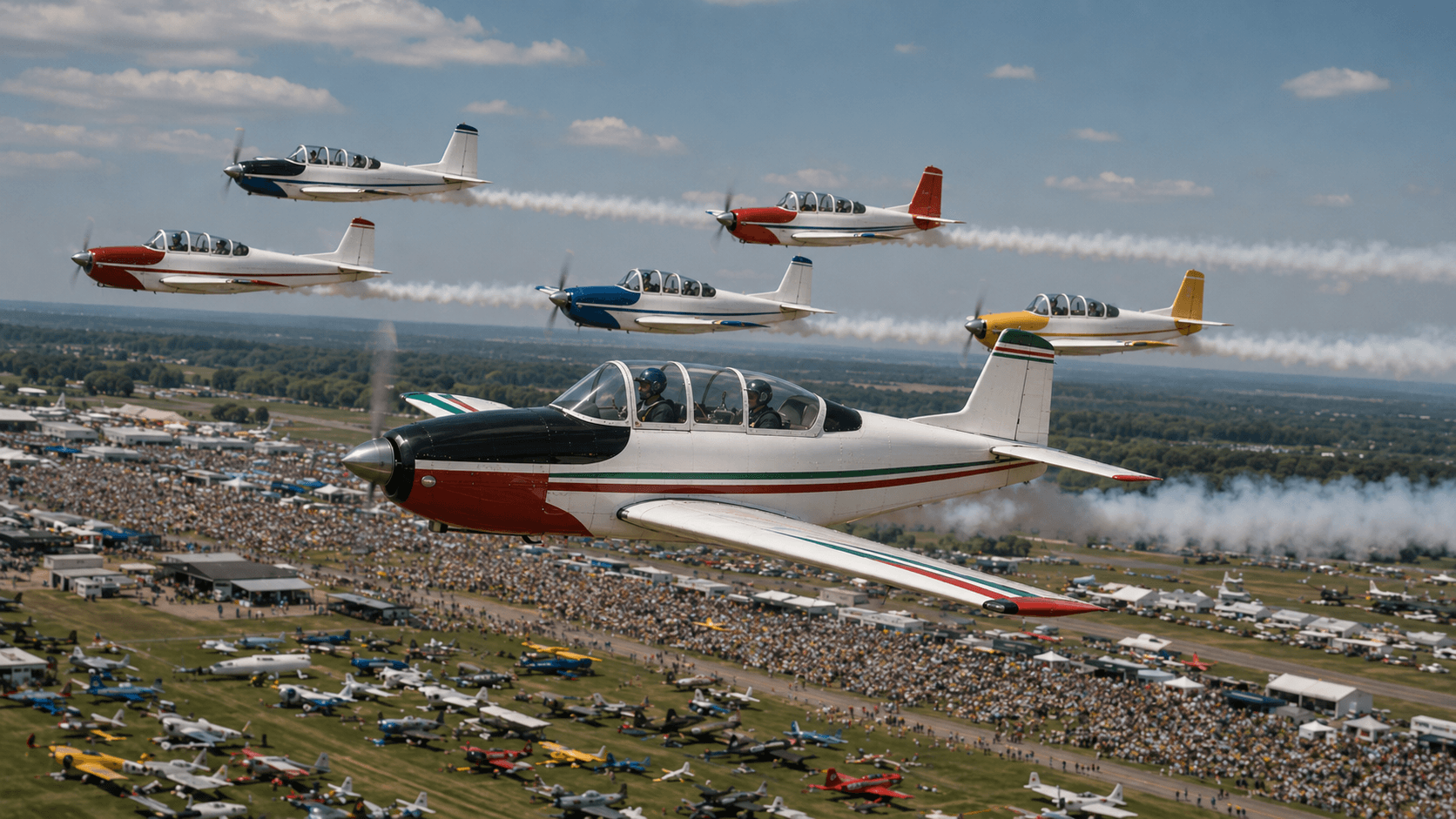
On the 28th, we flew to Oshkosh in a formation of thirty aircraft — divided into three diamonds of nine and a “V” at the end. During the first pass from south to north, Nancy, who was flying with me, cried with emotion as she experienced for the first time the beauty of flying among the trails of white smoke released by the Mentors over the spectators. Up there it is beautiful and very impressive. When we landed, still with her voice breaking from emotion, she said to me over the intercom: “Don’t sell it, don’t sell it.”
During the week of the festival, the weather was excellent, but at the end a warm front moved in and stalled, forcing me to return by Mexicana from Chicago and leave the Mentor in Oshkosh, so the adventure has not really ended.
My T-34 has a long history in Mexico. It was acquired by the CIAAC, the International Civil Aviation Training Center, and taken from Wichita, Kansas, to Mexico City on December 16, 1957. A month later it was flipped over in Chimalhuacán, when it had less than twenty hours of use. It is believed to be the only Mentor in history to have been flipped over. It was repaired, and in 1968 I learned to fly in it. When the CIAAC retired it in 1980, I acquired it after a year and a half of paperwork, but I could not find anyone to restore it. Finally, the CIAAC itself agreed to do it, and in December 1988, my Mentor took off from Santa Lucía. Over the last two years I have participated with it in Oshkosh.
Am I going to sell it? I think so, but if I finally decide not to sell it, I will keep it in the United States with a U.S. registration. In Mexico it is becoming increasingly difficult to fly and to justify owning an airplane like the Mentor. There are fewer and fewer small airstrips in remote and seldom-visited places. Maintenance is a real problem, because the mechanics who know the airplane are not “authorized shops,” so first I have to take it to a mechanic I trust and then “give a little something” to another one for the signature. Everything requires wasting time, filling out papers, and making payments — even for a ten-minute local flight! Flying cross-country is complicated: the Mentor’s engine consumes oil, and airports almost never have any, so I have to fill the baggage compartment with oil cans and put the luggage wherever I can. I also have to carry enough cash, because they do not accept bank cards for fuel payment. Anyway, why go on? We all know — except the DGAC — the aviation disaster we live in. It is shameful what they have done, and what we have allowed them to do, to Mexican aviation. Count on me in FEMPPA!
Editor’s note:
Alejandro Parra lives in Acapulco and is a full-time aviator. Professionally, he flies Mexicana de Aviación’s only Boeing 757, and in his free time he relaxes by flying the Mentor and a Super Cub. He frequently invites boys and girls to fly, to awaken their interest in aviation. When he is not flying, he organizes competitions and airshows. The time he has left he dedicates to building an RV-4 airplane, which he hopes to finish in five years, and to playing aerial combat games on the computer. He taught Nancy, his wife, who is a flight attendant, how to fly so they would have something to argue about.
A photograph of the Mentor in flight
(Translated by ChatGPT in June 2026)