FEMPPA and the DGAC Reach Agreements on the Civil Aviation Regulations (1998)

Report on a private meeting between FEMPPA's leadership and Director General of Civil Aeronautics Juan Antonio Bargés Mestres. During the meeting, objections to the proposed Civil Aviation Regulations were reviewed, several FEMPPA proposals were accepted, and new mechanisms for cooperation were established to address regulatory and administrative challenges affecting Mexican general aviation.
FEMPPA MEETING WITH THE GENERAL DIRECTOR OF CIVIL AERONAUTICS
On Thursday, August 20, Director General of Civil Aeronautics Juan Antonio Bargés Mestres held a private meeting lasting several hours with the President, Secretary, and Treasurer of FEMPPA.
During the meeting, Director Bargés acknowledged FEMPPA's efforts to improve the situation of general aviation in Mexico, expressed his support for the Federation's activities, and proposed a number of concrete actions.
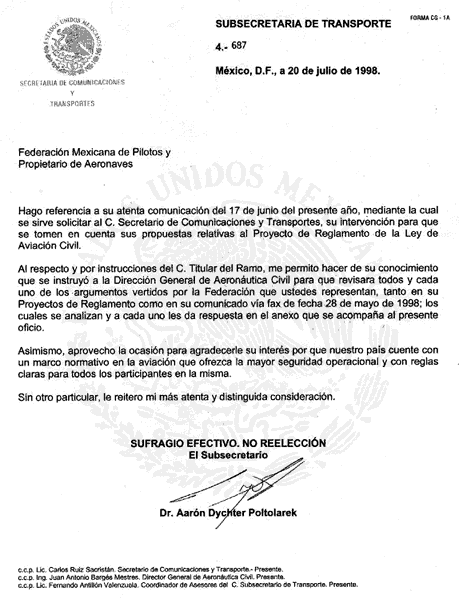
During the meeting, FEMPPA delivered hundreds of "JOIN FEMPPA" posters to the Director for distribution at airports throughout the country. In turn, the Director committed to distributing the posters and provided FEMPPA representatives with a letter from Undersecretary Aarón Dychter containing the official response to the objections that FEMPPA had submitted regarding the draft Civil Aviation Regulations prepared by the DGAC.
The response accepted several of FEMPPA's positions and stated that corresponding changes had been made to the draft regulations.
Among the accepted changes were the following:
a) Medical examinations would be required every two years for pilots under forty years of age.
b) It was clarified that private pilots may carry passengers in rented aircraft or aircraft owned by flying clubs.
c) The definition of "Air Festival" would be established through a regulatory standard.
d) Validation of foreign pilot licenses was accepted.
e) The obligation to report "any irregularity occurring during flight" was changed to reporting "any abnormality affecting flight safety operations."
f) It was accepted that there is no obligation to file a flight plan at uncontrolled airports.
g) The prohibition against passengers traveling in the "cockpit" was eliminated.
h) The requirement to carry radio equipment capable of covering "all" aviation frequencies was changed to carrying the "assigned communication frequencies."
i) Flight plans would be closed by radio with air traffic control.
j) The obligation to use radio navigation aids was eliminated.
k) It was clarified that participation in search-and-rescue operations would be required only "upon request of the Secretariat."
l) The requirement to "display a license in a visible place" was changed to simply "carry the license."
With respect to the requirement to carry an insurance policy on board, it was stated that the opinion of the National Insurance and Bonding Commission would be requested so that insurance companies could issue decals certifying that an aircraft was insured.
The remainder of the proposals were not accepted, including those related to simplifying or eliminating medical examinations for younger pilots, eliminating visual flight plans, allowing maintenance to be performed by mechanics rather than repair stations, and other issues.
Subject to FEMPPA providing additional justification and support for the proposals that were not accepted, Director Bargés explained that he personally agreed with FEMPPA on many points, but that they could not be incorporated into the regulations as desired because other government agencies participated in the review process and did not accept alternative viewpoints.
However, he offered to resolve practical obstacles administratively.
For example, he offered to authorize specific mechanics or instructors who were members of FEMPPA to sign the necessary logbook entries and thereby satisfy regulatory requirements; or, in the case of the requirement to obtain prior authorization for formation flights, to satisfy the requirement through a general authorization letter.
He also offered personalized treatment for FEMPPA members and requested that, instead of using intermediaries, FEMPPA members conduct their DGAC procedures through a designated FEMPPA employee. He further requested that FEMPPA provide him weekly reports regarding any "bureaucratic obstacle" encountered, committing himself to issue whatever instructions were necessary to resolve the problem.
(Translated in June 2026 by ChatGPT)