The Bargés Name Does Not Diminish Courage (1997)
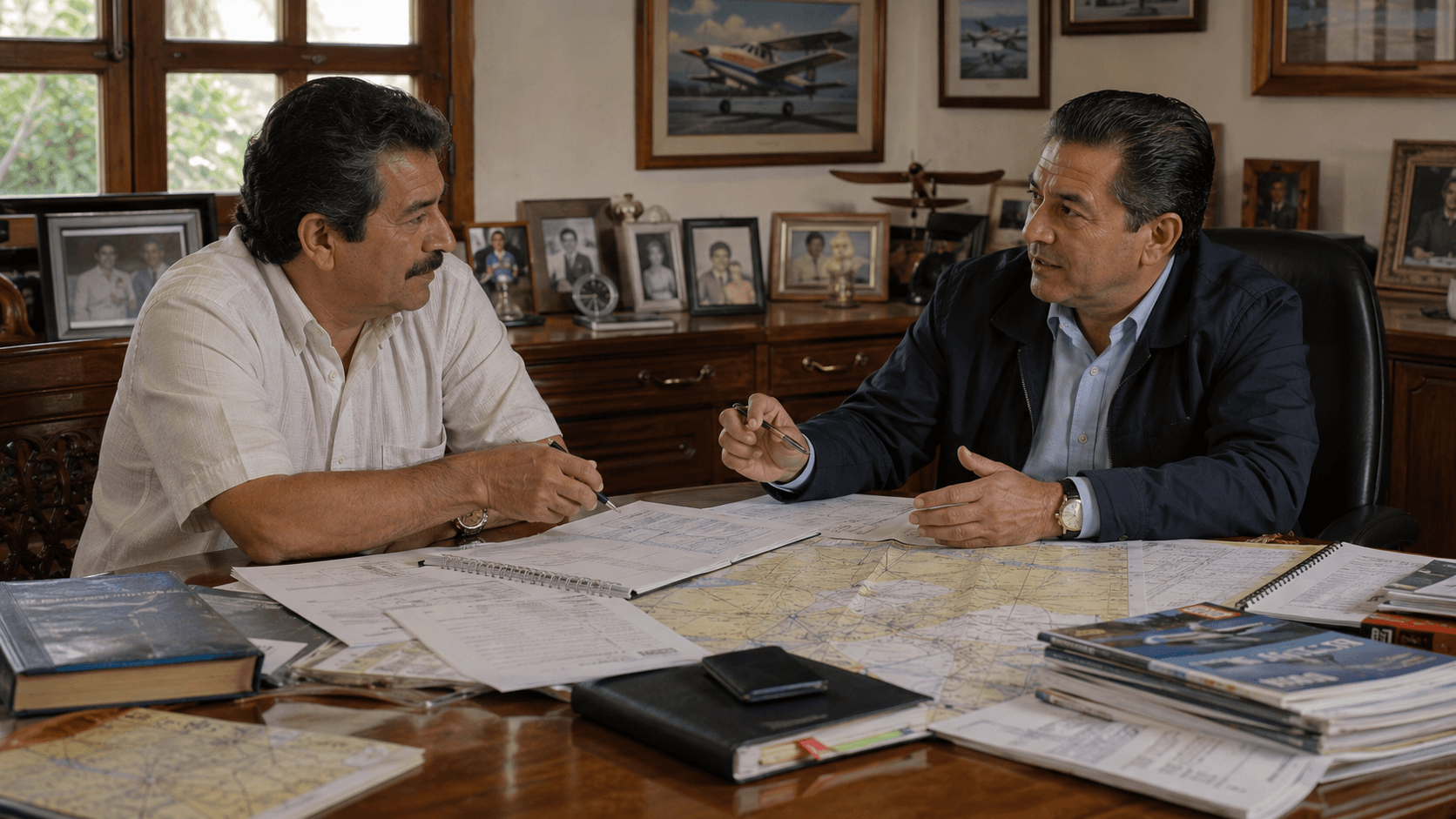
Opinion article published in Noti-AMPPA describing a meeting between the author and the then Director General of Civil Aeronautics, Antonio Bargés. The article discusses the challenges facing Mexican general aviation, the need for national organization among private pilots, efforts to combat corruption, and the beginning of a collaborative initiative to draft regulations specifically for light private aviation.
The following article was published in the August 1997 issue of the Noti-AMPPA newsletter
by José López del Puerto
Don Pepe and Doña Carmen Bargés were friends of my parents and grandparents. My grandparents, Spaniards from northern Spain, arrived in Mexico at the beginning of the century and in the 1940s acquired and managed for a time the Hotel Virreynal in Córdoba, Veracruz, where the young Catalan teachers José and Antonio Bargés had arrived after the Spanish Civil War. Of all of them, only my long-lived grandmother remains, soon to celebrate her hundredth birthday. My mother died almost thirty years ago, Don Antonio three or four years ago, Don Pepe two years ago, and Doña Carmen and my father a few months ago, only days apart.
When I received the Emilio Carranza Medal in January 1996, I sent my father the diploma.
"I didn't know Toño was involved with airplanes too," he commented, as if I knew what he was talking about.
"Which Toño?" I asked.
"Pepe Bargés' son," he informed me, "is one of the people who signed the diploma. Don't you remember Toño? He's your age and even dated one of your cousins."
"Well, no," I confessed. "I remember Don Pepe and Doña Carmen. Does she still do embroidery?"
That is how I learned who the Director General of Civil Aeronautics was. A mutual friend, Memo Fernández, had spoken very highly of him, but I had never connected him with "the Bargés family."
With that background, and the impression he made on me during a breakfast meeting between APPAC and DGAC officials, after the AMPPA Xalapa 97 Rally I felt confident enough to write him a letter—not to the government official, but to the man.
In it, I spoke about the problems of general aviation and how the DGAC, which had been a model government agency when I began flying, had become a model of incompetence and corruption, and about the poor reputation he, as director, had among private pilots. I concluded by telling him that I hoped he would keep the Bargés name at the level at which I had always known it.
When I returned from summer vacation, I found countless messages in my office saying, "The engineer Bargés' secretary called."
When I finally called back, she practically shouted with joy.
"I'm so glad you called, Architect! My boss wants to invite you to talk, and he no longer believes me when I tell him I haven't been able to locate you for two months."
I thought it was a courteous gesture.
We met one Saturday at the house that had belonged to his parents in Córdoba.
We talked at length about shared memories and about how he had reached his current position. He also told me about his personal projects and his work at the DGAC.
"Your friends are partly right," he told me, "because I have concentrated on commercial aviation, on the big operators, because that was where things were worst. Where the bribes were fifty thousand dollars and the disorder was enormous. That is over now. Mexicana is operating in the black. Three major Boeing maintenance facilities are going to open in northern Mexico. Grob is about to begin manufacturing aircraft in Mexico, and others will follow. The Chiapas aerotourism project started with Palenque. I still need to solve Taesa. Do you know anyone willing to invest thirty million dollars?
"My problem is that I have seventy-five fewer employees, very little time, and a tiny budget to attend to those who fly below 18,000 feet, who outnumber those flying above it—3,500 versus 300—but they are very fragmented. There are small clubs everywhere, but everyone works independently. Perhaps there should be a Deputy Directorate dedicated to private aviation, but for now I do not have the resources to create one."
"What I want to ask of you," he said, "is three things. First, organize yourselves so I have someone to talk to. Second, help me eliminate the corruption that still exists in some areas. And above all, help me draft the regulations that will govern you."
"For my part, I commit to recognizing your organization. I will personally address corruption complaints, provided there is no intermediary involved. And I will support the regulations that you propose. Draft them carefully and I will back you. You have the resources and the experience."
"I once again offer to place office space at your disposal"—I remembered that he had already offered this at the breakfast I attended—"inside the Directorate General, to be occupied by someone paid by you who can handle your affairs."
"The national organization is the most difficult part," I replied, "but we will try. Consider the regulations a done deal," I said, knowing the enthusiasm within AMPPA, APPAC, APPACHE, and the private pilot community. "But they will be exclusively for light private aviation, which is what we know. Regarding corruption, we will publicize the issue and see whether people come forward, because there is always fear of becoming the one left holding the bag. As for the office space, well, we will have to discuss the offer among ourselves. I cannot think of anyone who could occupy it."
As we said goodbye, he gave me a copy of Autumn Gusts, a book written by his father with wit and humor. I read it cover to cover that very night and found a phrase that fits this situation perfectly:
"Only when it is hot can iron be shaped."
Most of the friends with whom I have discussed that meeting have become enthusiastic. Some have told me that I am naïve for believing him.
The truth is that we will not know who is right until we do our part, and we need to do it together.
For the moment, at AMPPA we have gotten to work.
The first page of the nine-page draft regulation we have already written begins as follows:
REGULATIONS FOR LIGHT PRIVATE AVIATION
These regulations recognize the importance of Light Private Aviation as the foundation of aviation in Mexico and the obligation of the General Directorate of Civil Aeronautics to encourage its development.
1. DEFINITIONS
Light Private Aviation consists of light private aircraft, their crews, owners, and the organizations that bring them together.
Aircraft means any device that is used or intended to be used for flight in the air.
Light Private Aircraft (APL) means an aircraft heavier than air, intended for private transportation or recreation, with up to six seats, a maximum takeoff weight greater than 300 kilograms and up to 3,000 kilograms, owned by individuals or aviation clubs, or serving exclusively aviation clubs that do not obtain direct economic income.
Maximum Takeoff Weight means the maximum weight at which an aircraft is certified by the authority to take flight.
Direct Economic Income means the receipt of payment in cash or in kind for the lease or use of an aircraft or any part of an aircraft, its seats, cargo compartments, exterior surfaces, or flight capacity. Sharing among passengers only the expenses associated with a flight shall not be considered direct economic income. Membership fees paid by members to an aviation club for the use of aircraft owned by the club or serving exclusively the club shall not be considered direct economic income.
Personally and by telephone, we have already contacted some of you, and shortly we will send copies of the draft to clubs and associations so that they may study it and later discuss it at a meeting. The pilots from Puebla immediately offered to host it.
Although some, in a show of confidence, have told us that if the project was prepared by AMPPA they would support it without even reading it, we want it to be everyone's project.
We want it to be your project.
The newsletter contains AMPPA's address, e-mail, fax number, and telephone number.
Participate now.
Only when it is hot can iron be shaped.
José López del Puerto (translated in 2026 by ChatGPT)