FEMPPA Comments on the Proposed Civil Aviation Regulations (1998)
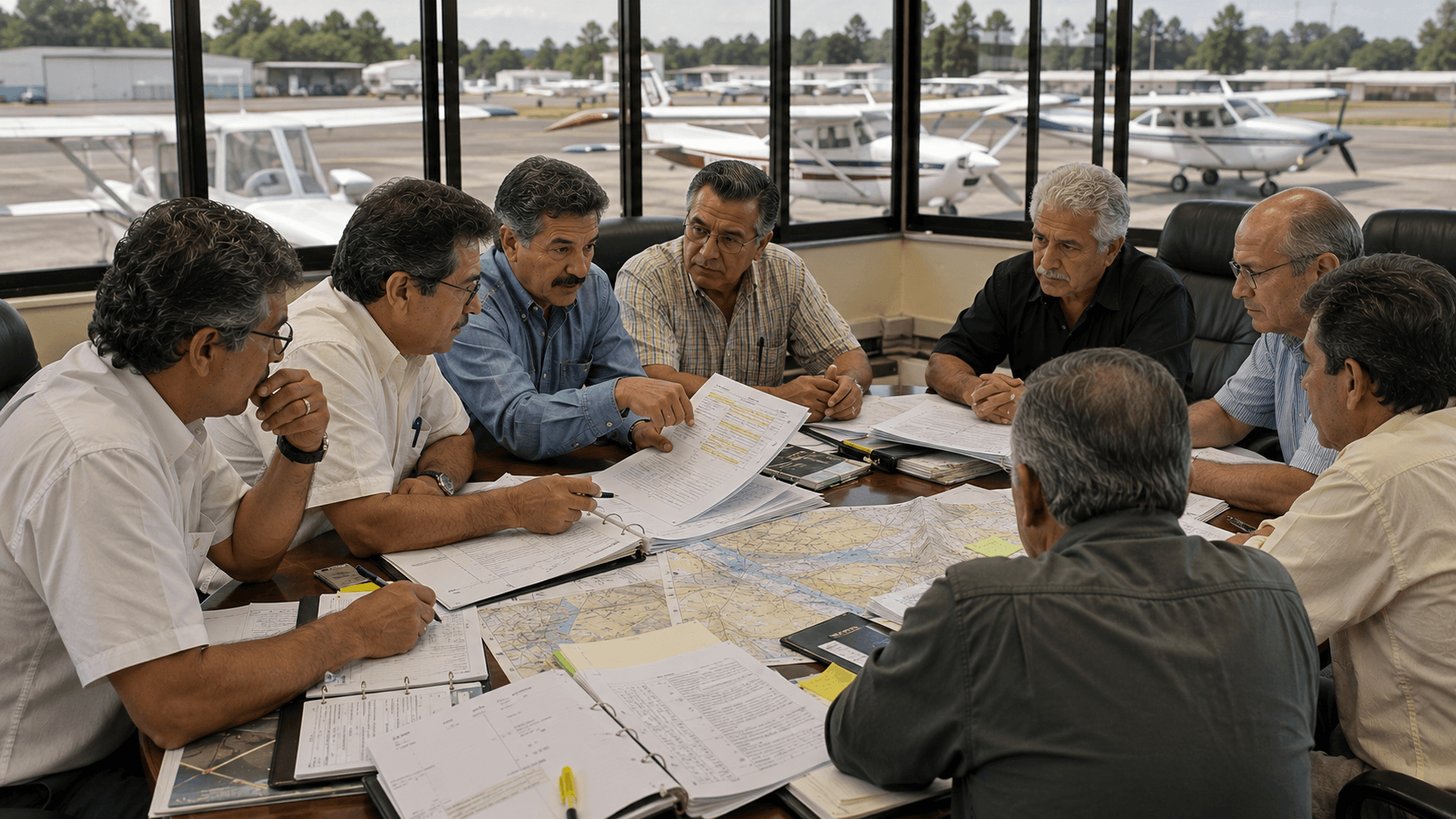
Position paper prepared by FEMPPA in response to the Civil Aviation Regulations proposed by the DGAC in 1998. The document outlines regulatory principles for non-commercial aviation and presents detailed comments on numerous provisions of the draft regulations, arguing that many imposed disproportionate, bureaucratic, or impractical requirements on light private aviation.
COMMENTS ON THE PROPOSED CIVIL AVIATION REGULATIONS PREPARED BY THE GENERAL DIRECTORATE OF CIVIL AERONAUTICS
May 27, 1998
FEMPPA believes that the current Civil Aviation Law is unfair and discriminatory toward non-commercial aviation and should therefore be amended.
For purposes of implementing the Law through regulations, the healthiest approach would be not to continue the mistake of giving identical treatment to all aviation activities, but rather to establish two separate sets of civil aviation regulations: one governing commercial operations and another governing non-commercial operations, so that there can be no confusion in their interpretation.
The fundamental points that a regulation MUST include regarding non-commercial aviation are:
a) Provide treatment distinct from commercial aviation.
b) Simplify all administrative procedures to the greatest extent possible.
c) Eliminate all unnecessary paperwork.
d) Eliminate the discretionary authority of aeronautical inspectors to ground an aircraft for administrative reasons.
e) Training may be conducted with any instructor and in any aircraft.
f) Medical examinations should be simple and required only every three years.
g) Mandatory onboard documentation should be kept to a minimum.
h) Maintenance and repairs should be performed by any qualified mechanic and in any country, in accordance with the manufacturer's requirements.
i) The visual flight plan should be abolished or completed in a simplified manner by radio or telephone.
j) Small aerodromes should operate under a simple process requiring minimal documentation. Placing obstacles on runways or digging trenches that prevent emergency landings should be considered criminal conduct.
k) The DGAC should be the sole authority. The Army, Attorney General's Office, Navy, Federal Highway Police, and state police forces should request information or documentation from the aeronautical authority, not from pilots or aircraft owners.
l) The costs of aeronautical infrastructure are covered by commercial aviation. Wherever commercial operations exist, non-commercial operations should be exempt from all charges (such as after-hours service extensions).
m) Non-commercial aviation already pays a surcharge on fuel that should cover all services and fees.
n) No rule, regulation, circular, or provision affecting non-commercial aviation should be issued without prior consultation with those affected.
o) Every aeronautical procedure, without exception, should be capable of being completed at any airport command office in the country chosen by the applicant.
p) Penalties should be substantially lower than those applicable to commercial aircraft for the same violation.
However, at the request of the Director General of Civil Aeronautics, we offer the following comments regarding the draft regulations proposed by the DGAC, which, as currently written, are even more harmful and unfair to non-commercial aviation than the Law itself.
Title Two, Chapter IV: Private Non-Commercial Air Transportation
Dynamic model aviation is included here, even though it is not "transportation."
The dictionary defines:
TRANSPORTATION. The action and effect of transporting.
TO TRANSPORT. To carry things or people from one place to another.
Articles 63 and 64
Dynamic model aviation is also so different from private air transportation that under no circumstances should it receive the same treatment.
Article 65
This provision is absurd. Under its terms, if I fly an aircraft owned by a club, I cannot carry my wife or a friend.
Article 66
The term "air festival" should be defined here so that it is not confused with rallies or air competitions among pilots that have no spectators.
I propose that it state:
"An air festival is a public aerial exhibition attended by spectators."
Article 71
This provision is bureaucratic and serves no practical purpose.
It should simply state that proof of insurance must be carried on board.
Article 78
Once again, equal treatment is being given to unequal activities.
It is reasonable for commercial pilot licenses to last one year, and transport pilot licenses perhaps even less, but private pilot licenses should be valid for at least three years.
Mexico is the only country I know where all pilot licenses have the same duration.
Article 79
"The Secretariat may validate licenses and certificates issued abroad by a competent authority, provided that..."
There should be no discretion involved.
The Secretariat must validate licenses and certificates, etc.
Article 80
"Aeronautical technical personnel must wear their licenses in a visible place while performing their duties."
This provision is ridiculous.
Must pilots and mechanics wear their licenses hanging around their necks in order to fly or change engine oil?
Article 82
Section III
Leaving everything to the "applicable regulations" leaves the matter open to arbitrariness.
It should specify that medical examinations for private pilots shall be limited to determining visual acuity, hearing acuity, and outward signs of health, and shall be valid for at least three years.
Section IV
All of this is excessive for a private pilot license.
No educational certificates of any kind should be required; only proof of flight instruction from a flight instructor and successful completion of the written and practical examinations.
Article 83, Section IV
The operation and capabilities of ultralight aircraft should be properly regulated by defining their limitations and the airspace in which they may operate privately, but under no circumstances should licenses be issued to operate them.
Issuing "commercial" ultralight licenses is equivalent to legalizing commercial operations with such aircraft, which should be completely prohibited.
Issuing "private" licenses defeats the very purpose for which ultralights exist: the ability to fly without complications.
An ultralight in the air is the equivalent of a bicycle on the ground.
Article 87
"For a pilot to be assigned command of an aircraft on a particular route..."
It should read:
"command of an aircraft on a particular commercial route."
Article 98
"The education, training, and instruction of aeronautical technical personnel shall be conducted in authorized training centers..."
The following should be added:
"except in the case of private pilots, who may receive training from any flight instructor and shall not be governed by this chapter."
Article 110
This article should apply only to commercial aviation, where pilots receive route-specific training.
How can a private pilot be expected to "know the civil aerodromes he uses and the services and facilities available there" if it is a place where he is landing for the first time?
Article 116
Likewise, this should apply only to commercial aviation, or the term "any abnormality" should be defined.
Otherwise, if I observe oil temperature ten degrees above or below normal, or if a bee enters through the air vent, I would be required to notify the Secretariat.
Article 120
This article should not apply to non-commercial aviation.
Article 123
This article should not apply to non-commercial aviation.
Flight plans for non-commercial operations should be filed by radio or telephone with only minimal information.
Article 125
This article should not apply to non-commercial aviation.
In small aircraft, passengers sit in the "cockpit" directly in front of the aircraft controls.
Article 128
This article should apply to non-commercial aviation, specifying that the pilot must ensure that passengers wear seat belts.
Article 131, Section VI
This section should not apply to non-commercial aviation.
There is no such thing as an "operational flight plan."
Likewise, there is no "flight plan" at uncontrolled airports.
Article 136
This article cannot be applied to non-commercial aviation.
Mexico lacks reliable and current meteorological information for low-altitude air navigation and lacks low-altitude radar coverage over most of the national territory.
Furthermore, so many airstrips have been closed and there are so few airports remaining that in many long-distance flights there is simply no alternative place to land.
For example, a small single-engine aircraft flying from Veracruz to Reynosa that discovers reduced visibility along the border region has no alternate airport within half an hour's flight time (Article 137) and will have to land however it can.
Article 143
This article is poorly drafted.
What is meant by "altitude and pressure appropriate to the elevation of the civil aerodrome"?
Article 145
This is very confusing.
I have no idea what "foreseeable risks" requiring "prior authorization from the Secretariat" are supposed to mean.
Article 146
Section I: Unnecessarily confusing and poorly drafted.
Section II: Not applicable to small aircraft.
Section III: Frankly absurd. No single-engine aircraft can continue flight if "one engine" fails. Neither can most light twins operating in the Valley of Mexico.
Section IV: Same observation as Section III.
Article 147
Unnecessarily confusing and poorly drafted.
Article 148
Not applicable to non-commercial transportation.
Article 149
A ten-day period for renewal of a certificate cannot be imposed because the aircraft would be unable to fly.
The certificate should be renewed immediately upon request.
Article 150
Not applicable to non-commercial transportation.
Article 151
Neither the turn-and-bank indicator nor the vertical speed indicator are primary visual-flight instruments and should not be included in the minimum equipment list.
Article 152
The turn-and-bank indicator (or a second attitude indicator) and the vertical speed indicator should be added here.
Article 153, Section V
Not applicable to non-commercial aviation.
Article 159
"Aircraft dedicated to passenger transportation shall have at least..."
Is this a new category, or does it refer to all aircraft with more than one seat?
It should specify:
"public passenger transportation."
Article 161, Section II
This provision is vague and should not apply to small aircraft.
For example, Tampico Airport has a lagoon on the approach to the commonly used runway (13). Would a small aircraft have to request a tailwind landing because it does not carry life vests?
Article 163
This article is linked to Article 159, which concerns public passenger transportation.
It should begin:
"Aircraft engaged in public passenger transportation..."
Articles 164 and 165
Same observation as Articles 159 and 163.
Article 166
Section I: Not applicable. Radios should not be mandatory for visual flight. Older aircraft do not even have electrical systems, and not even large jets carry equipment capable of using "all frequencies assigned to civil aviation."
Section II: Same observation.
Sections III and IV: Same observation. Furthermore, even when radios are installed, it is impossible to maintain communications "at any time during flight" while operating at low altitude.
Article 167
Absurd.
What does this mean for a small aircraft? That the compass must work?
Article 169
Equally absurd.
Not applicable to small aircraft.
Article 172
Maintenance and repair of non-commercial aircraft should be performed by aviation mechanics, not necessarily by repair stations.
The argument that "any mechanic can become an authorized repair station" is absurd and merely bureaucratic paperwork.
In that case, mechanic licenses should simply be abolished and replaced by repair-station certificates.
It should also be specified that maintenance performed abroad on non-commercial aircraft may be performed by a mechanic authorized in that country, who shall sign the aircraft logbooks.
What matters is safety, not paperwork.
Today many maintenance actions are performed by mechanics in Mexico and abroad, after which a repair station signature is purchased merely to comply with paperwork requirements.
Article 173
Not applicable to small aircraft.
There are so many aircraft types and they are so diverse that it is impossible for a mechanic to have completed "specific courses" for all of them.
Some aircraft models exist in only one or two examples in the entire country.
Article 175
Again, undefined.
What are "all related documents"?
For a small aircraft, the only documents that should be retained are the logbooks containing maintenance entries.
Chapter VIII, Articles 186 to 190
Nothing in this chapter should apply to small aircraft.
Article 193
Not applicable.
By definition, visual flight is conducted without using "air navigation services."
How can the pilot be required to use them?
Article 200
This article makes no sense.
A flight plan, when required, should be capable of being filed by telephone or radio, and that should end the pilot's responsibility.
Article 203
The only purpose of closing a flight plan is to confirm that the aircraft reached its destination.
The flight plan should be closed automatically by air traffic control when the aircraft is on the ground, or when the pilot reports being about to land at a nearby airport.
Expecting an aircraft to close a flight plan "within thirty minutes after arrival" by notifying the command office at "its departure aerodrome or the nearest aerodrome with such authority" is impossible when landing in locations without communications, as is the case in most towns and ranches.
Article 204
Flight plans should be capable of being filed verbally and should require neither paperwork nor signatures.
Article 208
It should state:
"Provided the aircraft is equipped with communication equipment and is operating at an altitude permitting communications."
In many parts of Mexico it is impossible to establish communications at low altitude because there are not enough relay stations.
Article 219
The obligation should apply not only to events (which are unforeseen), but also to the operational condition of airports, communication systems, and navigation aids.
Article 221
It should read:
"When operating aircraft in CONTROLLED airspace."
What purpose does the Aeronautical Information Publication serve at a ranch airstrip?
Article 229
The following should be added:
"except when coordination and communication exist among the pilots involved, as in formation flight."
Article 241
The provision is excessively broad.
As written, it would mean that every aircraft in the country, without exception, must take off whenever another aircraft is in danger.
Article 243
How can an aviation regulation impose obligations on non-aviators?
It is unnecessary to state that "any person with reliable knowledge of an accident must report it."
Article 248
Absurd.
According to this article, could an aircraft voluntarily participating in search-and-rescue operations later be sanctioned for not carrying a list of coastal maritime service facilities?
Article 263
This may be applicable to company employees, but not to private pilots.
As previously stated, medical examinations should be limited to certifying visual and hearing acuity.
Article 264
The regulations should require the Secretariat to respond to requests submitted to it.
It is a mockery to establish that:
"Requests not resolved within the period established for each case shall be deemed denied."
This also conflicts with other laws.
It should instead state:
"They shall be deemed granted."
The regulations should also incorporate all of the fundamental principles listed at the beginning of these observations.
May 27, 1998.
jlp. (Translated by ChatGPT June 2026)