Proposed Regulations for Private Non-Commercial Air Transportation (1998)
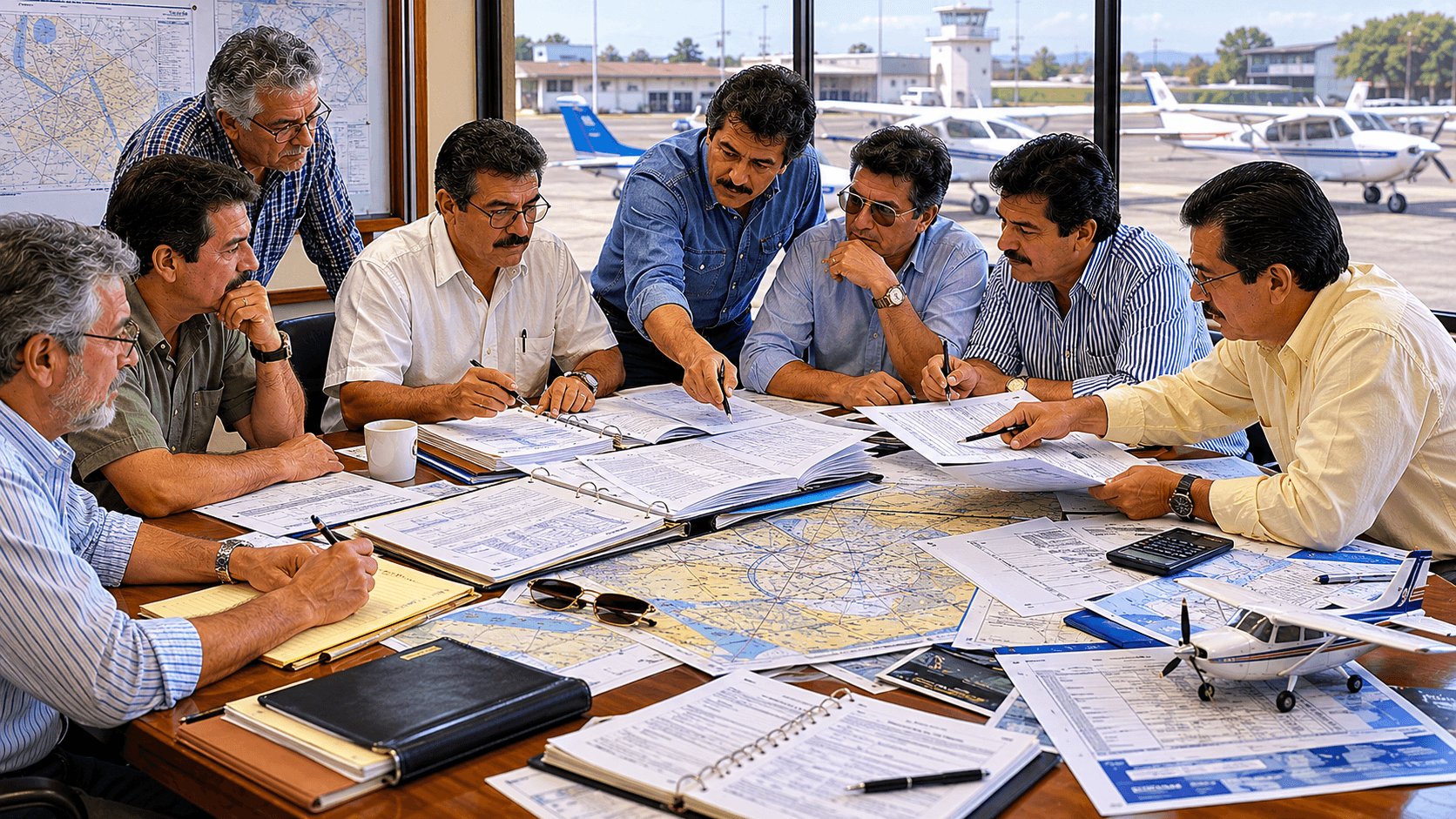
Institutional proposal prepared by FEMPPA and Mexican associations of private aircraft owners and pilots, submitted to the General Directorate of Civil Aeronautics in February 1998. The proposal sought to establish a regulatory framework specifically for private non-commercial aviation, distinguishing it from commercial aviation and addressing licensing, maintenance, airworthiness, operations, aerodromes, amateur-built aircraft, and aviation community representation.
Proposed Regulations for Private Non-Commercial Air Transportation
Prepared by
FEMPPA
and the associations of private aircraft pilots and owners of the Mexican Republic
and submitted in February 1998 to the General Directorate of Civil Aeronautics
EXPLANATORY STATEMENT
In the statement of reasons with which the Civil Aviation Law was submitted to the Chamber of Deputies of the Congress of the Union, it was established that the initiative sought to achieve seven fundamental objectives, namely:
First: To update the legal framework applicable to civil aviation while maintaining national sovereignty over the airspace;
Second: To promote the development of air transportation systems under conditions of safety and continuity;
Third: To strengthen the powers of the Ministry of Communications and Transportation as the aeronautical authority;
Fourth: To consolidate the regulation of the use and exploitation of the airspace located over national territory under conditions of fair competition and environmental protection;
Fifth: To define the system for granting concessions and permits for the operation of air routes, taking into account the importance represented by each modality in the provision of air services;
Sixth: To organize and regulate the different forms of air transportation and define the fare and competition structures applicable to each of them; and,
Seventh: To support the healthy development and modernization of national airlines within the new framework of international competition.
From reading these objectives, the remainder of the statement of reasons, and the Civil Aviation Law itself, it is obvious that it was drafted almost exclusively with public air transportation services in mind, despite the fact that such services represent barely ten percent of the aircraft in the country.
The first two chapters of the Law deal with "General Provisions" and "The Aeronautical Authority," only to proceed immediately, in the third chapter, to address "Concessions and Permits," which concern only public and commercial transportation, instead of addressing "The Use of Mexican Airspace," which would be of general application and public interest.
The Law specifically devotes only three articles to Private Non-Commercial Air Transportation, to which the immense majority of Mexican aircraft belong, yet it generalizes throughout the entire Law the provisions established for public transportation, giving equal treatment to unequal parties, without respect for the general principles of law. Private Non-Commercial Air Transportation cannot receive the same treatment as public or commercial transportation simply because it is not a service, even though the Law mistakenly includes it within the chapter entitled "Air Transportation Services."
Examples of legal aberrations include Article 35, which establishes the mandatory use of radio navigation aids and airways for navigation within national airspace, and Article 88 of the Law, which imposes fines of three hundred to three thousand minimum wages for "failing to use during aircraft operations the services and facilities of air navigation aids and other auxiliary services," when the majority of aircraft in Mexico operate under Visual Flight Rules (VFR), whose fundamental characteristic is navigation based on visual observation rather than radio navigation aids.
Three thousand minimum wages, moreover, may not be significant for a public transportation aircraft carrying hundreds of passengers, but exceeds the value of many two-seat aircraft.
The Civil Aviation Law must be modified in order to fairly encompass all aspects of civil aviation in Mexico. This proposed Regulation for Private Non-Commercial Air Transportation, prepared in coordination with the Director General of Civil Aeronautics, Juan Antonio Bargés Mestres, by FEMPPA and the Mexican associations representing pilots and owners of private non-commercial aircraft, seeks to correct the shortcomings of the Civil Aviation Law by establishing a framework that encompasses all aeronautical aspects involved in Private Non-Commercial Air Transportation.
Private aircraft are generally small and very different from public transportation aircraft, and it is absurd to apply the same rules to their operation and maintenance.
For example, the principal argument for requiring medical examinations of private pilots has been the fear that they may suffer incapacitation while in flight and be unable to operate their aircraft. However, it has been statistically demonstrated that accidents caused by health problems among private pilots do not exceed one percent of the total annual number of accidents, and that this percentage does not vary when medical examinations are not required, because the conditions that suddenly incapacitate a pilot are inherently unpredictable.
In the United States, after analyzing the statistics of such accidents over the last fifty years, the ASF (Aviation Safety Foundation) has recommended that the FAA (Federal Aviation Agency) eliminate medical examinations for certain licenses. The recommendation is currently pending approval by the DOT (Department of Transportation).
The logical course of action is for Mexican private pilots to self-assess their health condition before each flight and for available medical resources to be concentrated on examinations of commercial pilots (which should be conducted by aviation medicine specialists rather than by general practitioners, as is generally the case today). This regulation points in that direction.
Likewise, the maintenance and repair of light private aircraft, which constitute the bulk of Private Non-Commercial Air Transportation, cannot be governed by the same standards as other aircraft. Responsibility should rest with their owners and aviation mechanics, not with bureaucratic paperwork that encourages irregularities.
At present, for example, owners are required to overhaul aircraft engines or airframes upon reaching certain arbitrarily established operating hours, regardless of their actual condition. To comply with this requirement, the owner must request authorization, submit numerous documents, undergo inspections, make payments, and so on. As a consequence, many have chosen the simple expedient of not recording all flight hours in the aircraft logbooks.
In other cases, owners obtain falsified maintenance paperwork in order to comply when the requirement is clearly absurd, such as the requirement to disassemble an aircraft that has not been abused and has received proper maintenance in order to perform magnetic-flux inspections of the landing gear—a routine inspection not even recommended by aircraft manufacturers.
The mere existence of this type of anachronistic rule is evidence of the collusion that once existed between the aeronautical authority and certain repair shops that benefited from captive business, while at the same time inspections performed abroad were prohibited.
It must be understood that those who do not fly for business care more about safety than bureaucracy or paperwork, and will overhaul an engine or airframe when required by condition, regardless of whether it has reached the limit established by the authority or exceeded it.
Just as certification of the airworthiness of light private aircraft should rest exclusively with aviation mechanics, certification of pilot training should rest exclusively with flight instructors. Requiring a person seeking to become a pilot of a light private aircraft to enroll in an aviation school and complete a course lasting hundreds of hours is as absurd as requiring a motorist to do the same in order to drive an automobile.
The objective, as in the case of aircraft maintenance, should be safety, not paperwork or the favoritism of particular businesses. This regulation reflects that reality.
In aeronautical operations, safety depends upon the condition of the aircraft and upon the judgment and experience of the crew. Modern light aircraft, when properly maintained, very rarely suffer catastrophic failures. The principal cause of fatal accidents is poor decision-making by the pilot under otherwise normal flight conditions. Nevertheless, in Mexico pilots are still required to practice emergency procedures annually, as in the era when engines failed frequently, rather than normal flight procedures.
However, when a failure does occur, preservation of life depends on finding a suitable place to land. In recent years, thousands of airstrips in Mexico have been destroyed under the pretext of combating drug trafficking, an absurd policy that would require the destruction of roads, ports, beaches, telephones, and everything else that drug traffickers might use. Destroying or rendering airstrips unusable should be considered a criminal act punishable by law.
Aerodromes become fundamentally important during natural disasters when ground transportation is interrupted, as recently occurred during the hurricanes that struck the coasts of Oaxaca and Guerrero. Assistance had to be delivered by helicopter, which is scarce and costly, when it could have been delivered more rapidly and at lower cost by airplane had sufficient aerodromes existed in the region.
The Ministry of Communications and Transportation must ensure the preservation of existing aerodromes and establish permanent programs that encourage the construction of new ones.
Light private aircraft are the foundation of a nation's aviation, and for that reason, in Mexico as in many countries, their operation should be subsidized by commercial aviation and by the nation itself.
From an official standpoint, non-commercial civil aviation uses essentially the same aeronautical infrastructure that would be required for commercial, governmental, and military aviation alone. The important difference lies in the fact that commercial aviation generates and receives economic benefits, whereas non-commercial aviation generates benefits alone, consuming goods and services, creating jobs, fostering tourism, promoting technological development, and awakening interest in aviation.
Non-commercial aviation should be officially encouraged by freeing it from every expense that is not absolutely indispensable and, when such expenses are necessary, simplifying their payment to the greatest extent possible.
This is the policy followed by the countries with the most developed aviation sectors and the policy reflected in this regulation.
The preparation of these Proposed Regulations for Private Non-Commercial Air Transportation has been an arduous task that FEMPPA and the Mexican associations of private non-commercial aircraft pilots and owners have undertaken with enthusiasm, patriotism, and responsibility, for the benefit of Mexico—a country whose size, beauty, and geography are ideally suited to general aviation and which will become the natural destination of thousands of small aircraft that cross the skies of North America when confidence exists in our aeronautical regulations and infrastructure.
Regulations for Private Non-Commercial Air Transportation
CHAPTER ONE
GENERAL PROVISIONS
1.1 PURPOSE AND OBJECTIVES
These regulations govern Private Non-Commercial Air Transportation, as defined in Article 28 of the Civil Aviation Law published in the Official Gazette of the Federation on May 12, 1995, pursuant to the decree signed by the President of the Republic on May 10, 1995.
The provisions of these regulations have the following objectives:
a) To establish the basic provisions for planning, organizing, and regulating Private Non-Commercial Air Transportation and to promote its development and growth.
b) To establish coordination and cooperation among the entities involved in Private Non-Commercial Air Transportation for the organization and regulation of the use of Mexican airspace and aeronautical facilities.
c) To establish the basic standards for the promotion, implementation, and execution of programs that encourage the growth and development of Private Non-Commercial Air Transportation.
d) To establish the basic standards that encourage the construction, preservation, and improvement of aeronautical facilities.
e) To promote the participation of civil society in aeronautical activities.
1.2 COMPETENT AUTHORITY
The enforcement of these regulations shall be the responsibility of the Federal Executive Branch, which shall exercise its authority directly or through the Ministry of Communications and Transportation, acting through the General Directorate of Civil Aeronautics.
1.3 EXCLUDED AIRCRAFT
Aerostats, ultralight aircraft, model aircraft, and other similar devices referred to in Article 30 of the Civil Aviation Law shall be governed by their specific regulations and not by these regulations.
CHAPTER TWO
DEFINITIONS
For the purposes of these Regulations, the following definitions shall apply.
Civil Aerodrome means a defined area of land or water suitable for the takeoff, landing, water landing, or movement of aircraft, with the minimum facilities or services necessary to ensure the safety of its operation.
STOL Civil Aerodrome means a civil aerodrome suitable only for the operation of STOL aircraft.
Water Aircraft means an aircraft capable of landing on water.
Amphibious Aircraft means an aircraft capable of both landing and alighting on water.
Amateur-Built Aircraft (ACC) means a TAP-NC aircraft built by an individual for recreational, educational, or experimental purposes.
Aircraft means any self-propelled vehicle that is used or intended to be used to transport persons, cargo, or mail through the airspace.
TAP-NC Aircraft means any aircraft dedicated to Private Non-Commercial Air Transportation.
Light TAP-NC Aircraft means an aircraft heavier than air, with a maximum takeoff weight of up to 5,700 kilograms and an empty weight greater than that established by the authority for ultralight aircraft.
Heavy TAP-NC Aircraft means an aircraft heavier than air, with a maximum takeoff weight exceeding 5,700 kilograms.
STOL TAP-NC Aircraft means an aircraft capable of taking off and landing, at sea level, within a runway length of 300 meters or less.
Ultralight Aircraft means an aircraft heavier than air with an empty weight of up to 115 kilograms, or such weight as may be established by the authority in the applicable regulations.
Airplane means a fixed-wing aircraft powered by one or more engines and supported by the dynamic reaction of the air against its wings.
Airport means a public-use civil aerodrome equipped with the facilities and services necessary for the reception and dispatch of aircraft.
Autogyro means a rotary-wing aircraft whose freely rotating rotor turns through the action of the air as the aircraft moves forward propelled by one or more propellers.
Logbook means a record book in which data relating to flights conducted by a pilot or to the operation, maintenance, and repair of an aircraft are entered chronologically.
Medical Certificate means a document issued by an Aviation Medical Examiner certifying that its holder is physically fit to operate an aircraft at the time of examination.
Aircraft Commander means the pilot in command of an aircraft and is responsible for its operation.
Designated Examiner means a pilot who, in recognition of his or her knowledge, is designated by the authority to evaluate a student. A Designated Examiner may not receive financial compensation for such services.
Propeller means a set of blades which, when rotated by an engine, produces thrust that propels an aircraft forward without generating lift.
Helicopter means a rotary-wing aircraft powered by one or more engines and capable of hovering flight.
Heliport means a civil aerodrome intended exclusively for helicopter operations.
Flight Instructor means a Commercial Pilot authorized by the authority to provide flight instruction in exchange for financial compensation.
Designated Instructor means a pilot who, in recognition of his or her knowledge, is designated by the authority to provide flight instruction. A Designated Instructor may not receive financial compensation for such services.
The Authority means the Ministry of Communications and Transportation acting through the General Directorate of Civil Aeronautics.
The Law means the Civil Aviation Law published in the Official Gazette of the Federation on May 12, 1995.
Profit means the receipt of payment for the transportation of passengers or cargo, or for the use of an aircraft in specialized air services. Profit shall not include the sharing among aircraft occupants exclusively of expenses associated with a flight, nor the receipt of fuel and travel expenses from the organizers of an airshow to which the pilot or aircraft has been invited. Profit shall also not include fees paid by members of an aviation club for the use of aircraft owned by or dedicated to the club.
Aviation Medical Examiner means a person authorized by the DGAC to issue Medical Certificates.
Engine means a machine that generates power and is attached to an aircraft to make it fly or move through the air.
Occupant means any person aboard an aircraft.
Passenger means any occupant other than the aircraft commander.
Maximum Takeoff Weight means the maximum weight at which an aircraft is certified to become airborne.
Pilot means a person licensed to operate an aircraft.
Pilot in Command means the commander of an aircraft.
Airplane Airframe means the assembly consisting of the fuselage, wings, control surfaces, and landing gear of an airplane, excluding engines, propellers, rotors, and their accessories.
Glider means a fixed-wing aircraft supported by the dynamic reaction of the air against its wings, whose free flight does not depend primarily on an engine.
Regulations means these Regulations.
Designated Reviewer means a pilot who, in recognition of his or her knowledge, is designated by the authority to conduct flight procedures reviews. A Designated Reviewer may not receive financial compensation for such services.
Rotor means a mechanism incorporating an aerodynamic surface which, when rotating, produces lift or maintains the direction of a rotary-wing aircraft.
Specialized Air Services means aerial photography, aerial surveying, commercial advertising, aerial spraying, weather modification, and aircraft training and instruction conducted in aircraft operated by a flight school.
Private Non-Commercial Air Transportation (TAP-NC) means transportation intended for private use without profit motive and consists of aircraft dedicated to such use, their owners, and the aviation clubs and associations that represent them.
Aerobatic Flight means a flight in which the pilot intentionally performs maneuvers involving abrupt changes in aircraft attitude, or attitudes and accelerations not necessary for normal flight.
CHAPTER 3
MINIMUM EQUIPMENT FOR TAP-NC AIRCRAFT
3.1 FOR VISUAL FLIGHT (VFR)
Airspeed indicator.
Altimeter.
Magnetic compass.
Tachometer for each engine.
Oil pressure gauge for each engine using a pressurized oil system.
Oil temperature gauge for each air-cooled engine.
Engine temperature gauge for each liquid-cooled engine.
Manifold pressure gauge for each engine capable of developing maximum takeoff power at altitudes above sea level.
Fuel quantity indicator for each tank.
Landing gear position indicator if the landing gear is retractable.
Safety belt with metal-to-metal buckle for each seat.
Shoulder harness for each seat from which the aircraft controls may be operated.
One Emergency Locator Transmitter (ELT).
Flotation devices for each occupant if the aircraft is operated over oceans or gulfs at an altitude lower than that required to reach the nearest shore in a power-off glide.
3.2 FOR INSTRUMENT FLIGHT (IFR)
All equipment required under Section 3.1 for VFR flight.
The equipment necessary to communicate with air traffic services and the navigation equipment necessary to utilize the radio navigation aids required for the intended flight.
Sensitive altimeter adjustable for atmospheric pressure.
Slip-and-skid indicator.
A gyroscopic rate-of-turn indicator and a gyroscopic attitude indicator (artificial horizon). The rate-of-turn indicator may be replaced by a second attitude indicator powered by a system independent of the first.
An onboard clock capable of displaying hours, minutes, and seconds.
Generator, alternator, or battery of sufficient capacity for the flight.
3.3 ADDITIONAL NAVIGATION EQUIPMENT
3.3.1 For Visual Flight
A TAP-NC aircraft not equipped for instrument flight may have electronic navigation equipment and instruments installed.
3.3.2 For Instrument Flight
A TAP-NC aircraft equipped for instrument flight may have navigation equipment installed that is not certified for instrument flight, but such equipment may not be used as the primary means of navigation.
CHAPTER 4
TRAINING AND LICENSING
To act as pilot in command of a Mexican-registered TAP-NC aircraft in Mexico, a minimum of a Mexican Student Pilot License shall be required.
To operate a foreign-registered TAP-NC aircraft in Mexico, a minimum of a Private Pilot License shall be required, issued either by Mexico or by the country in which the aircraft is registered.
4.1 FLIGHT TRAINING
4.1.1 Regulation
A pilot applicant may choose to receive training at a flight school authorized by the authority, in which case the applicant shall be subject to the applicable regulations, or from one or more independent instructors in a TAP-NC aircraft, in which case the applicant shall be subject to the provisions established herein.
4.1.2 Age and Authorization
There shall be no minimum age requirement and no authorization from the authority shall be required to receive flight training in a TAP-NC aircraft from a flight instructor.
4.1.3 Documentation
In order to be recognized by the authority, training received must be described and signed by the instructor in the student's flight logbook.
The logbook shall not require authorization from the authority to be opened.
Flight training initiated at a flight school may be continued in a TAP-NC aircraft, provided it is recorded in the student's logbook and signed by a flight instructor.
4.1.4 Solo Flight
A student may not conduct solo flight unless he or she has reached sixteen years of age, holds a Student Pilot License, and has received a solo flight endorsement from an instructor.
If the student is a minor, a letter of consent from a parent or guardian shall also be required.
4.2 STUDENT PILOT LICENSE
4.2.1 Requirements
a) Be able to speak, read, and write Spanish.
b) Hold a Medical Certificate.
c) Possess a flight logbook.
4.2.2 Privileges and Restrictions
a) License and Logbook
The license and flight logbook shall be carried aboard the aircraft, except during local flights, in which case they may be kept at the airport.
Each flight shall be recorded in the logbook, indicating its nature and the number of landings performed.
b) Local Solo Flight
To conduct local solo flight, a Student Pilot must possess a logbook endorsement issued by an instructor authorizing a specified number of solo flights and identifying the make and model of the TAP-NC aircraft.
Weather conditions at the time of flight shall be at least equal to the minimum requirements for visual flight, and the crosswind component shall not exceed five knots.
The student may not proceed more than ten nautical miles from the airport of departure nor land at a different airport, except in cases of emergency or becoming lost.
c) Solo Cross-Country Flight
To conduct solo cross-country flight, a Student Pilot must possess a logbook endorsement issued by an instructor authorizing a specified number of flights to an airport other than the departure airport, identifying the make and model of the TAP-NC aircraft and the departure and destination airports.
The minimum weather conditions along the route shall be those required for local solo flight.
A Student Pilot may land at an airport other than those authorized by the instructor only in cases of emergency or becoming lost.
d) Passengers
A Student Pilot may not carry passengers in a TAP-NC aircraft unless he or she has received twenty hours of instruction, completed local solo flight, and the passenger is a licensed pilot with more than 300 hours recorded in a logbook and occupies a seat with access to the aircraft controls.
e) Validity
The Student Pilot License shall expire upon issuance of a Private Pilot License.
4.3 PRIVATE PILOT LICENSE
4.3.1 Requirements
a) Have reached seventeen years of age.
b) Possess a letter of consent from a parent or guardian if a minor.
c) Hold a Student Pilot License.
d) Hold a Medical Certificate.
e) Pass the Aviation Knowledge Examination.
f) Pass the Practical Flight Examination.
4.3.2 Aviation Knowledge Examination
The Aviation Knowledge Examination shall consist of a written or computer-based test in which the applicant must correctly answer at least seventy percent of a maximum of 200 multiple-choice questions covering aviation knowledge.
4.3.3 Practical Flight Examination
The Practical Flight Examination shall consist of a flight during which a Designated Examiner evaluates whether the Student Pilot is qualified to obtain a Private Pilot License.
To take the examination, the Student Pilot shall:
a) Have passed the Aviation Knowledge Examination.
b) Have a logbook certification from an instructor stating that, in the instructor's judgment, the Student Pilot is qualified to take the examination.
c) Have recorded in the logbook at least the minimum required experience and training.
4.3.4 Minimum Experience and Training Required for the Practical Flight Examination
a) Airplane: 40 hours of flight time in aircraft, of which at least 10 hours shall be solo flight, 20 hours instruction, and 15 of those hours in airplanes.
b) Helicopter: 40 hours of flight time in aircraft, of which at least 10 hours shall be solo flight, 20 hours instruction, and 15 of those hours in helicopters.
c) Glider: 70 solo glider flights regardless of total flight time, or 7 hours of solo glider flight and 35 solo glider flights, or 40 hours in airplanes and 10 solo glider flights.
d) Autogyro: 40 hours of flight time in aircraft, of which at least 10 hours shall be solo flight, 20 hours instruction, and 15 of those hours in autogyros.
4.3.5 Validity
The Private Pilot License shall remain valid indefinitely, subject to the privileges and restrictions established in these Regulations.
4.3.6 Privileges and Restrictions
a) License
The Private Pilot License shall be carried aboard the aircraft except during local flights, when it may be kept at the airport.
b) Medical Condition
No pilot may operate a TAP-NC aircraft without holding a Medical Certificate and carrying it aboard the aircraft, except during local flights, when it may be kept at the airport.
No pilot may operate a TAP-NC aircraft if he or she knows that his or her health condition at the time of flight could jeopardize flight safety.
c) Logbook
Each flight shall be recorded in the logbook, indicating its nature and the number of landings performed.
The logbook must have been verified by the authority within the preceding three years and need not be carried aboard the aircraft, but it must contain evidence of compliance with the requirements established in these Regulations.
d) Passengers
No pilot may carry passengers in a TAP-NC aircraft unless the logbook reflects at least three landings during the preceding three months and at least three flight hours during the preceding six months as pilot in command of an aircraft of equal or greater weight and power than the aircraft to be flown.
e) Flight Procedures Review
No pilot may operate a TAP-NC aircraft unless the logbook reflects completion of a Flight Procedures Review with an instructor or reviewer within the preceding twenty-five months.
f) Recent Experience
No pilot may operate a TAP-NC aircraft unless the logbook reflects flight as pilot in command of an aircraft within the preceding twelve months, unless the pilot completes a Flight Procedures Review with an instructor or reviewer.
g) High-Powered Aircraft
No pilot may operate a single-engine TAP-NC aircraft with more than 200 horsepower unless the logbook contains certification by an instructor that the pilot has received training and is qualified to do so.
h) Complex Aircraft
No pilot may operate a TAP-NC aircraft equipped with a controllable-pitch propeller, turbocharged engine, retractable landing gear, or pressurized cabin unless the logbook contains certification by an instructor that the pilot has received training and is qualified to do so.
i) Conventional Landing Gear
No pilot may operate a TAP-NC aircraft equipped with a tailwheel or tailskid unless the logbook contains certification by an instructor that the pilot has received training and is qualified to do so.
j) Amphibious and Water Aircraft
No pilot may operate on water a TAP-NC aircraft equipped for water landings unless the logbook contains certification by an instructor that the pilot has received training and is qualified to do so.
k) Glider Towing
No pilot may operate a TAP-NC aircraft while towing a glider unless the logbook contains certification by an instructor that the pilot has received training and is qualified to do so.
l) Formation Flight
A pilot may conduct formation flight only when the flight has been coordinated with each pilot in command of the participating aircraft and the pilot's logbook contains certification by an instructor that the pilot has received training and is qualified to do so.
m) Supplemental Oxygen
No pilot may operate a TAP-NC aircraft for more than thirty minutes above 12,500 feet cabin altitude, or at any time above 14,000 feet cabin altitude, unless all occupants continuously use supplemental oxygen.
For night operations, the altitudes specified above shall be reduced by 2,000 feet.
n) Safety Equipment
No pilot may operate a TAP-NC aircraft over the sea at an altitude lower than that required to glide to shore without power unless personal flotation equipment capable of keeping the face of an unconscious person above water is readily available for each occupant.
For operations over land, a TAP-NC aircraft shall carry such safety, emergency, or survival equipment as the pilot considers necessary for the flight.
o) Category and Class
No pilot may operate a TAP-NC aircraft falling within a classification different from that shown on the pilot's license, except while receiving training under the supervision of a flight instructor.
p) Visual Meteorological Conditions (VMC)
The pilot in command of an aircraft operating under a Visual Flight Rules (VFR) flight plan may fly in VMC without maintaining visual contact with the terrain below only when holding an instrument rating.
q) Instrument Meteorological Conditions (IMC)
Except in emergencies, no pilot may operate a TAP-NC aircraft in Instrument Meteorological Conditions (IMC) without instrument flight training and authorization from Air Traffic Control.
4.3.7 Courtesy License
Any person holding a valid Private Pilot License or higher issued by the aeronautical authority of an ICAO member state may obtain a Mexican Private Pilot License merely by demonstrating proficiency in either Spanish or English.
The license shall remain valid indefinitely and shall bear the statement:
"Valid only when accompanied by a valid foreign license."
4.3.8 Validation
Any training completed in an ICAO member state shall be recognized in Mexico by the authority upon presentation of supporting documents certified by a Mexican diplomatic mission in that country.
4.4 MEDICAL CERTIFICATE
Holders of Student Pilot or Private Pilot Licenses (except Courtesy Licenses) shall possess a Medical Certificate issued by an Aviation Medical Examiner.
4.4.1 Validity
The Medical Certificate shall remain valid for thirty-seven months.
4.4.2 Medical Examination
Holders of Student Pilot and Private Pilot Licenses are responsible for self-assessing their general state of health before each flight.
The Aviation Medical Examiner shall certify only that, at the time of examination, the applicant meets the following critical health requirements necessary for flight:
a) Vision. Distant and near visual acuity of 20/40 or better, with corrective lenses if necessary, using both eyes open while viewing a standard eye chart. If corrective lenses are required, the certificate shall state: "Must fly with corrective lenses."
b) Hearing. Ability, with or without electronic amplification worn externally, to understand words spoken behind the applicant at a distance of 1.5 meters in a quiet room at normal conversational volume. If amplification is required, the certificate shall state: "Must use hearing amplification equipment."
c) Speech. Ability to pronounce intelligible words and phrases. If unable to do so, the certificate shall state: "Authorized to fly only in uncontrolled airspace."
d) Mental Condition. Absence of symptoms of mental or neurological disorders, or dependence on alcohol or drugs.
4.5 FLIGHT PROCEDURES REVIEW
A Flight Procedures Review consists of a two-hour session with an instructor or designated reviewer, of which at least one hour shall be flight time, during which aircraft operating procedures are discussed and practiced.
The instructor or designated reviewer shall certify completion of the review in the logbook.
The review is not an examination; however, any practical flight examination shall satisfy the requirement for a Flight Procedures Review.
4.6 LOGBOOK VERIFICATION
At least once every three years, a pilot shall present his or her logbook at any airport command office so that the authority may verify that it is current and record the flight hours for statistical purposes.
The authority shall note in the logbook that the verification has been completed.
A pilot who chooses not to exercise his or her pilot privileges temporarily shall not be required to present the logbook for verification.
CHAPTER 5
AIRWORTHINESS
A TAP-NC aircraft shall be considered airworthy when it complies with the provisions established in this chapter and when the pilot, during the preflight inspection, does not find any condition that could endanger flight safety.
5.1 DOCUMENTATION ON BOARD
Every TAP-NC aircraft shall carry the following documents on board:
a) Certificate of Airworthiness. The Certificate of Airworthiness certifies that the aircraft possesses a Certificate of Registration and shall therefore be considered its legal substitute.
b) The aircraft flight manual or the list of emergency procedures established by the manufacturer.
c) Navigation charts appropriate to the nature of the flight, whether published in printed or electronic form. Such charts shall not be required when the aircraft conducts visual flights within a radius of 50 nautical miles from its home airport.
5.2 CERTIFICATE OF AIRWORTHINESS
A document identifying an aircraft, issued by the authority, indicating the identity of the owner and the nationality, registration, and characteristics of the aircraft, certifying that the aircraft was in an airworthy condition at the time of issuance.
5.2.1 Requirements for Initial Issuance of a Certificate of Airworthiness
a) Present a Certificate of Registration.
b) Present logbooks showing that the TAP-NC aircraft has undergone Annual Inspection and Maintenance within the preceding twelve months.
c) Present proof of civil liability insurance coverage.
5.2.2 Validity of the Certificate of Airworthiness
Unlimited, provided that the aircraft does not change ownership, the owner does not change address, and the characteristics of the aircraft described in the certificate remain unchanged.
5.2.3 Amendment of the Certificate of Airworthiness
Whenever any information contained in the Certificate of Airworthiness of a TAP-NC aircraft becomes inaccurate, the owner shall have thirty days to notify the authority, which shall issue a new Certificate incorporating the necessary modifications.
5.3 REGISTRATION MARKINGS AND NATIONAL FLAG ON TAP-NC AIRCRAFT
TAP-NC aircraft shall display externally, on both sides of the fuselage, the complete registration shown on the Certificate of Registration, in letters not less than ten centimeters in height and in a color contrasting with the background.
TAP-NC aircraft may display representations of the national flag, provided they comply with the provisions of the Law on the National Flag, Coat of Arms, and National Anthem.
5.4 MAINTENANCE, REPAIR, AND MODIFICATION OF TAP-NC AIRCRAFT
5.4.1 Heavy TAP-NC Aircraft
TAP-NC aircraft with a maximum takeoff weight exceeding 5,700 kilograms shall comply with the same maintenance and repair standards applicable to commercial aircraft.
5.4.2 Light TAP-NC Aircraft
Maintenance, repair, or modification work on TAP-NC aircraft with a maximum takeoff weight of up to 5,700 kilograms shall be performed by aviation mechanics authorized by the DGAC when performed in Mexico, or by the aeronautical authority of an ICAO member state when performed abroad, subject to the following:
a) No authorization from the authority shall be required to perform maintenance, repair, or modification work on an aircraft.
b) Maintenance or repair of an aircraft airframe shall be performed by a mechanic holding an airframe rating.
c) Maintenance or repair of an aircraft engine shall be performed by a mechanic holding an engine rating.
d) Major repairs to a propeller shall be performed by a propeller repair facility authorized by the aeronautical authority of an ICAO member state.
e) Replacement of engines or propellers shall be performed by a mechanic holding an engine rating. The owner shall present the corresponding logbook to the authority for verification within thirty days following the first flight after the replacement. The authority shall make any necessary amendments to the Certificate of Airworthiness.
f) Modifications to aircraft characteristics specified in the Type Certificate shall be approved through a Supplemental Type Certificate (STC) by the aeronautical authority of the country where the modification is performed.
g) Any mechanic performing work on an aircraft shall record and sign a general description of the work performed in the appropriate logbooks.
h) In the case of Amateur-Built Aircraft (ACC) holding a permanent Certificate of Airworthiness, the builder shall acquire the status of an authorized airframe and engine mechanic for that aircraft. The owner of an ACC not built by him or her shall not acquire such status.
5.4.3 Annual Inspection
At least every thirteen months, all systems of a Light TAP-NC Aircraft shall be visually inspected by a mechanic holding both airframe and engine ratings. Preventive maintenance shall be performed in accordance with the manufacturer's recommendations, and any necessary repairs shall be completed.
The mechanic shall record in the appropriate logbooks that the aircraft has received proper maintenance, that all inspections or modifications established as mandatory in manufacturer bulletins published by the Mexican Aeronautical Registry have been completed, and that the aircraft is in an airworthy condition.
5.4.4 Time Between Overhaul (TBO) or Major Inspection
The airframes, engines, and propellers of Light TAP-NC Aircraft may continue in service as long as they remain airworthy in the judgment of the mechanic conducting the annual inspection.
Manufacturer-recommended or authority-established times between overhauls (TBOs) or major inspections shall not apply to TAP-NC aircraft.
5.5 TAP-NC AIRCRAFT LOGBOOKS
Every TAP-NC aircraft shall maintain the appropriate logbooks recording operating time and all maintenance and repair work performed.
The logbooks shall be verified by the authority at least every thirteen months, except when the aircraft is not in operating condition.
The logbooks should preferably be kept in a secure location but may be carried aboard the aircraft if the pilot or owner so desires.
5.6 INSURANCE
Every TAP-NC aircraft shall maintain civil liability insurance coverage.
The insurance policy or proof of insurance should preferably be kept in a secure location but may be carried aboard the aircraft if the pilot or owner so desires.
5.7 EXTENSIONS
The deadlines established in this chapter shall be extended by the authority when requested by the owner before their expiration, provided that reasons of force majeure preventing timely compliance are presented.
CHAPTER 6
OPERATIONS
6.1 FLIGHT PLAN
6.1.1 Local Flight
When a TAP-NC aircraft wishes to conduct a local flight from a controlled airport, it shall be sufficient for the pilot to provide the air traffic controller with the aircraft registration, make, and model for the flight plan required by law to be considered filed.
The pilot may, if desired, complete a local flight report form and retain a copy.
6.1.2 Visual Flight (VFR)
When a TAP-NC aircraft wishes to depart from a controlled airport under Visual Flight Rules, it shall be sufficient for the pilot to provide the air traffic controller with the aircraft registration, make and model, proposed altitude, and destination for the flight plan required by law to be considered filed.
The pilot may, if desired, complete a visual flight plan form and retain a copy.
The proposed altitude shall be that prescribed for VFR flights according to the direction of flight, except where such altitude would be less than 3,000 feet above the terrain.
When conducting a visual flight, the pilot shall navigate primarily by reference to the terrain and may use electronic navigation systems as supplementary aids if desired.
6.1.3 Special Visual Flight (Special VFR)
When weather conditions at a controlled airport are below VFR minimums, but visibility is at least two miles and the pilot has information indicating that the adverse weather conditions affecting the airport are only local in nature, it shall be sufficient for the pilot to advise air traffic control and provide the information required in the preceding section for the flight plan required by law to be considered filed and for departure under Special VFR to be authorized.
The pilot may, if desired, complete a visual flight plan form and retain a copy.
6.1.4 Instrument Flight (IFR)
When a TAP-NC aircraft wishes to conduct an Instrument Flight Rules (IFR) flight, the pilot shall provide the flight plan to dispatch or air traffic control services by telephone, radio, or in person, at the pilot's discretion.
The pilot may, if desired, complete an IFR flight plan form and retain a copy.
6.1.5 Flight Plan Closure
Upon arrival at its destination, a TAP-NC aircraft's flight plan shall be considered closed.
The pilot may, if desired, complete an arrival report form and retain a copy.
6.2 PROMOTION OF INTEREST IN AVIATION
When a TAP-NC aircraft is operating under visual flight conditions more than 2,000 feet above the terrain, the pilot may, for the purpose of encouraging interest in aviation, allow a non-pilot passenger to operate the aircraft controls under the pilot's direct supervision.
6.3 OPERATION OF TAP-NC-STOL AIRCRAFT
TAP-NC-STOL helicopters, autogyros, and airplanes, which by their nature do not require aerodromes for operation, may land or take off from any terrain that the pilot considers suitable, provided that the safety of the aircraft and third parties is not endangered.
6.4 OPERATION OF AIRCRAFT ON WATER
Aircraft capable of alighting on water may do so on any body of water that the pilot considers suitable, provided that the safety of the aircraft and third parties is not endangered.
6.5 AEROBATIC FLIGHT
A TAP-NC aircraft certified for aerobatic flight shall not require authorization from the authority to conduct aerobatic flight, except when conducted:
a) In controlled airspace.
b) At less than 1,500 feet above the terrain.
c) Within ten miles of a controlled airport.
d) Over a populated area.
6.6 OPERATION OF TAP-NC AIRCRAFT AT CIVIL AIRPORTS
No runway, taxiway, or parking apron at a civil airport where a TAP-NC aircraft is present may be considered a restricted area.
Pilots and passengers of TAP-NC aircraft shall have free access to and from public roads.
Customs, immigration, judicial, police, or military authorities, where present at a civil airport, shall maintain facilities and aprons separate from those used by the general public.
Outside such restricted areas, the Airport Command Office, subject to the limitations established by the Law and these Regulations, shall be the only authority authorized to inspect or require documents from a TAP-NC aircraft or its occupants.
6.7 OPERATIONS AT MILITARY FACILITIES
Whenever a military airport or aerodrome permits the operation of TAP-NC aircraft, such aircraft shall be governed by the provisions of these Regulations applicable to TAP-NC operations.
In times of peace, no civil airport or aerodrome may be converted into a military facility, placed under military jurisdiction or surveillance, or lose its civil status.
CHAPTER 7
TAP-NC AERODROMES
TAP-NC aerodromes are those used primarily by Light TAP-NC Aircraft, located in rural or undeveloped areas, with runways between 500 and 1,400 meters in length at sea level, or those lengths increased by ten meters for every one hundred feet of elevation.
7.1 DEVELOPMENT AND SAFETY
The SCT, acting through the DGAC, shall be the sole authority with jurisdiction over the regulation of TAP-NC aerodromes.
The responsibilities and functions of the authority shall be:
a) To promote the construction, rehabilitation, and operation of aerodromes as a means of fostering aviation development and safety.
b) To defend the existence and unrestricted operation of national aerodromes against any other federal, state, or municipal authority.
c) To comply on behalf of the owner with any requirement or obligation imposed or purportedly imposed by any authority other than the SCT for the construction or operation of a TAP-NC aerodrome.
7.2 TAP-NC-STOL AIRSTRIPS
TAP-NC-STOL airstrips are strips of undeveloped land less than 500 meters in length at sea level, or 500 meters plus ten meters for every one hundred feet of elevation, located in rural areas and used primarily for the operation of TAP-NC-STOL aircraft.
TAP-NC-STOL airstrips shall not be required to register with the authority.
7.3 REGISTRATION
TAP-NC aerodromes shall be registered with the SCT and only with the SCT.
Compliance with any registration or authorization required by any authority other than the SCT shall be the responsibility of the SCT.
To register a TAP-NC aerodrome, it shall be sufficient to notify the authority in writing of its exact coordinates, elevation above sea level, runway orientation and length, and the identity of the owner or possessor, together with copies of documents establishing ownership or possession of the property.
TAP-NC-STOL airstrips shall not be considered aerodromes and need not be registered, although the owner may choose to register them.
7.4 AUTHORIZATION
A TAP-NC aerodrome shall not require authorization for construction or operation provided that, when constructed, it:
a) Has a slope not exceeding six percent.
b) Is free of obstacles within a strip thirty meters wide on either side of the runway centerline.
c) Is free of obstacles within one hundred meters beyond each runway end.
d) Is free of populated areas within one kilometer beyond either runway end following the runway extension.
e) Is located more than five kilometers from a controlled airport.
7.5 OPERATION
TAP-NC aerodromes form part of the Nation's General Communications Routes, and their owners shall maintain them in conditions that ensure the safe operation of any aircraft requiring an emergency landing.
The deliberate placement of obstacles that prevent aircraft from landing shall be considered criminal conduct because it endangers the integrity of an aircraft attempting to land and the lives of its occupants.
The Ministry of Communications and Transportation shall report such acts to the judicial authorities.
Owners of aerodromes may not charge any fee to visiting TAP-NC aircraft.
7.6 OVERSIGHT
The supervision and oversight of TAP-NC aerodromes shall be the exclusive responsibility of the SCT through Airport Command Offices.
Police or military forces may not require aeronautical documents from owners or users of TAP-NC aerodromes, nor obstruct or restrict runways in a manner that endangers the safety of aircraft attempting to use them.
7.7 SUSPENSION OF OPERATIONS
The SCT, acting through the General Directorate of Civil Aeronautics, shall be the sole authority authorized to suspend operations at an aerodrome.
Such suspension may occur only through written notice to the owner, publication of the corresponding NOTAM, and publication of the suspension notice in the Official Gazette of the Federation.
The suspension shall become effective thirty days after the notice and publications have been completed.
If a court orders the suspension of operations at an aerodrome, the SCT shall follow the procedure established herein to comply with the order.
The thirty-day period may not be reduced under any circumstances.
The SCT shall be responsible for complying with ICAO requirements to ensure that aircraft in flight can clearly determine that the aerodrome is inoperative.
CHAPTER 8
AMATEUR-BUILT TAP-NC AIRCRAFT
An Amateur-Built TAP-NC Aircraft (ACC) is a TAP-NC aircraft constructed by an individual for recreational, educational, or experimental purposes. No authorization from the authority shall be required to construct an ACC.
8.1 CLASSIFICATION
a) From Parts. Aircraft constructed using parts from factory-built aircraft.
b) From Plans. Aircraft constructed from drawings and plans using parts manufactured by the builder.
c) From Kits. Aircraft constructed by assembling a kit acquired from a manufacturer.
8.2 CERTIFICATE OF NATIONALITY AND REGISTRATION
Once more than fifty percent of the airframe of an ACC has been constructed, the authority shall issue a Certificate of Nationality and Registration upon application by the builder.
8.3 TEST FLIGHTS AND CERTIFICATION
8.3.1 Test Pilot
Test flights in an ACC shall be conducted by a pilot holding a Private Pilot License or higher and endorsed to operate an aircraft of similar characteristics.
8.3.2 Type Certificate
ACC aircraft shall not require a Type Certificate.
8.3.3 Initial Inspection of an ACC
Upon completion of construction, the builder shall submit the ACC to a thorough inspection by an aviation mechanic, who shall certify in writing that, in his or her judgment, the aircraft has been constructed in accordance with accepted aviation practices and that its weight and balance are within limits, and shall therefore recommend that flight testing be conducted.
8.3.4 Provisional Certificate of Airworthiness
Upon presentation of the recommendation referred to in the preceding section, the authority shall issue the ACC a provisional Certificate of Airworthiness for the purpose of conducting flight tests for a period of one year.
If the flight testing has not been completed within that period, the ACC may undergo a new initial inspection and receive a new provisional Certificate of Airworthiness.
8.3.5 Cross-Country Test Flights
A powered ACC may not conduct cross-country test flights until it has completed ten hours of local flight testing.
8.3.6 Passengers
An ACC may not carry passengers until it has obtained a permanent Certificate of Airworthiness, except when the passenger holds a pilot license equal to or higher than that of the pilot in command and has access to a second set of aircraft controls.
8.3.7 Final Inspection of an ACC
After completing twenty hours of flight testing in the case of powered aircraft, or thirty-five flights in the case of gliders, the owner shall submit the ACC to a thorough inspection by an aviation mechanic, who shall certify in writing that, in his or her judgment, the aircraft is in an airworthy condition and recommend issuance of a permanent Certificate of Airworthiness.
8.4 CERTIFICATE OF AIRWORTHINESS
Upon presentation of the ACC logbook showing completion of the required flight testing and successful completion of the Final Inspection, the authority shall issue a permanent Certificate of Airworthiness.
8.5 OPERATING RULES
The operating rules applicable to ACC aircraft shall be the same as those applicable to all other TAP-NC aircraft, except where these Regulations provide otherwise.
CHAPTER 9
TAP ORGANIZATIONS
TAP Organizations are federations, associations, and clubs that bring together owners and pilots of private air transportation aircraft.
9.1 REGISTRATION
Every TAP Organization shall have the right to register with the authority whenever it chooses.
A TAP Organization shall be considered registered with the authority upon written notification of its existence, accompanied by copies of documents evidencing its lawful incorporation.
9.2 RIGHT TO INFORMATION
The authority shall be obligated to notify registered TAP Organizations directly and in writing and to request their opinions regarding any provision affecting Private Air Transportation at least ninety days before such provision enters into force.
9.3 RIGHT TO EXPRESS OPINIONS
The opinions of TAP Organizations on aviation matters shall be taken into consideration by the authority.
Whenever a provision affecting Private Air Transportation enters into force without consideration of the opinions of TAP Organizations, compliance with such provision shall not be mandatory.
9.4 RIGHT TO PARTICIPATE
TAP Organizations shall participate in committees, meetings, study groups, analysis groups, information forums, discussions, or advisory bodies established by the authority concerning matters that directly or indirectly involve, or could involve, Private Air Transportation.
9.5 AIR COMPETITIONS AND AIRSHOWS
The authority shall have the obligation to promote and facilitate air competitions and airshows as a means of encouraging aviation.
9.5.1 Authorization
TAP Organizations shall require authorization from the authority to conduct air competitions or airshows only when such events:
Involve controlled airspace;
Are open to the general public; or
Include aerobatic flight requiring air traffic control authorization under these Regulations.
9.5.2 Application for Authorization
Whenever authorization is required under these Regulations, organizers may submit an application up to two years in advance.
The authority shall grant authorization within fifteen calendar days from receipt of the application, except where force majeure prevents the event from being held, in which case the authority shall coordinate with the organizers to make whatever adjustments are necessary to grant approval.
9.5.3 Revocation of Authorizations
Because air competitions and airshows require extensive planning and organizational expenses well in advance, the authority may not revoke an authorization once granted except pursuant to a judicial order.
CHAPTER 10
SUPPLEMENTARY PROVISIONS
10.1 FEES AND CHARGES
10.1.1 Use of Mexican Airspace
TAP-NC operations shall be exempt from all charges for the use of Mexican airspace and for air navigation and air traffic control services provided therein, except when services are extended beyond the normal operating hours of an airport and the airport is not otherwise open for commercial operations.
When two or more TAP-NC aircraft request such service extensions, the corresponding charges shall be prorated among them.
10.1.2 Airport Fees, Charges, and Services
TAP-NC operations shall be exempt from all airport and aerodrome fees, charges, and service costs, except for the use of overnight parking aprons or hangars, or when services are provided outside normal airport operating hours and the airport is not open for any other aeronautical operation.
10.1.3 Use of Overnight Hangars and Parking Aprons
Charges to TAP-NC aircraft for overnight hangar use may not exceed five minimum wages of the Federal District per night.
Charges for overnight apron parking may not exceed two minimum wages per night.
TAP-NC aircraft shall be exempt from all charges for daytime apron use.
10.1.4 Fines and Penalties
Fines applicable to TAP-NC operations shall range from 20 to 200 minimum wages and shall not exceed 200 minimum wages or the minimum amount specified by law.
An exception shall apply to the deliberate obstruction of runways, for which fines shall range from 10,000 to 100,000 minimum wages of the Federal District, without prejudice to any criminal or civil liability arising from endangering human life or violating the General Communications Routes Law and other applicable laws and regulations, including the Public Officials Liability Law when the obstruction was caused by a public official.
10.2 IMPLIED APPROVAL
Whenever a TAP-NC member does not receive a response within fifteen calendar days to a written request submitted to the authority directly or through an Airport Command Office, the request shall be deemed legally approved.
10.3 TERRITORIAL JURISDICTION
Any TAP-NC administrative procedure before the DGAC may be conducted through any Airport Command Office chosen by the applicant.
TAP-NC operators shall not be required to conduct procedures or make payments at offices other than Airport Command Offices or at any specific Airport Command Office.
10.4 MEXICAN AERONAUTICAL REGISTRY
The Mexican Aeronautical Registry shall be responsible for:
a) Maintaining current databases and making them available to aircraft owners, pilots, mechanics, and the general public, including publication on the Internet, containing:
Registration number, make and model, and owner name and address for all Mexican civil aircraft.
Name and address, license class and number, and medical certificate validity for all Mexican pilots.
Name and address, license class and number, and license validity for all Mexican aviation mechanics.
Name, address, and telephone number of all Aviation Medical Examiners.
Name, address, and telephone number of all registered aviation clubs and associations.
b) Obtaining, maintaining, and making available to aircraft owners, pilots, mechanics, and the general public all service bulletins issued by manufacturers of aircraft registered in Mexico.
A summary of all bulletins issued during the previous month shall be distributed monthly to Airport Command Offices and published on the Internet.
10.4.1 Registration of Documents Issued by the Authority
Any document issued by the authority shall be considered registered in the Mexican Aeronautical Registry whenever the Law requires such registration.
10.4.2 Registration of Aircraft Modifications
Any modification or information appearing in a TAP-NC aircraft logbook shall be deemed registered in the Mexican Aeronautical Registry once the logbook has been verified by the authority and whenever the Law requires such registration.
10.4.3 Registration of Insurance Policies
Any insurance policy issued to a TAP-NC aircraft by a Mexican insurer, or by a foreign insurer legally operating in Mexico, shall be deemed automatically registered in the Mexican Aeronautical Registry.
10.5 AIRCRAFT INSPECTIONS
10.5.1 Grounds for Inspection
The authority, through Airport Commanders, may require owners or pilots of transient TAP-NC aircraft to demonstrate possession of the documentation required by these Regulations only when the pilot has committed an infraction of these Regulations or has been involved in an incident or accident.
10.5.2 Documentation Required On Board
When the authority requests documentation required to be carried on board and the aircraft or pilot does not possess it, the authority shall issue a report and the affected party shall have seven days to present the documentation at an Airport Command Office and pay any applicable fine.
10.5.3 Documentation Not Required On Board
When the authority requests documentation not required to be carried on board, the authority shall issue a report and the affected party shall have thirty days to present the documentation at an Airport Command Office.
10.5.4 Airworthiness
When the authority requests documentation and it is not produced, the pilot and aircraft may continue operating legally until the deadlines established in this chapter expire.
If the documentation is not presented before the expiration of those deadlines, neither the pilot nor the aircraft shall remain legally authorized to operate.
10.6 RETROACTIVITY
The provisions of these Regulations shall apply retroactively whenever doing so benefits TAP-NC pilots or aircraft, but under no circumstances may they be applied retroactively to their detriment.
10.7 VALIDITY OF OTHER RULES
Any provision contained in other regulations, circulars, or official documents that conflicts with or imposes requirements different from those established in these Regulations shall be considered invalid with respect to TAP-NC operations.
10.8 PETITION FOR RECONSIDERATION
Individuals who consider themselves adversely affected by decisions adopted by the Ministry of Communications and Transportation or the General Directorate of Civil Aeronautics in the application of these Regulations or any other rule or provision may seek relief through a Petition for Reconsideration.
10.8.1 Time Limit
The petition shall be filed within fifteen business days from the date of notification of the challenged decision, or from the date on which the affected party becomes aware of it by any means.
10.8.2 Requirements
The petition shall be submitted in writing to the same authority that issued the challenged decision and shall state, at a minimum:
The name and address of the petitioner for purposes of notification;
The act or decision being challenged; and
The grounds for disagreement.
10.8.3 Suspension
The authority shall suspend execution of the challenged act or decision, provided that doing so does not harm the public interest.
10.8.4 Decision
The authority hearing the petition shall issue the appropriate decision within a reasonable period.
TRANSITIONAL PROVISIONS
Sole Article. Within thirty days following the entry into force of these Regulations, the authority shall conduct a comparative review of the Civil Aviation Law and submit proposed amendments to those articles and chapters that fail to distinguish between public and commercial air transportation and non-commercial air transportation, or that are inconsistent with the provisions established in these Regulations.
(Translated by ChatGPT in 2026)